Application
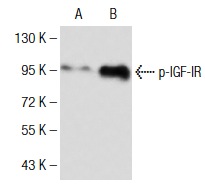
Western blot analysis of IGF-IR phosphorylation expression in untreated (A) and insulin treated (B) 293 whole cell lysates.| Product Name | p-IGF-IR Antibody (Tyr 1280) |
|---|---|
| Antibody Type | Primary Antibodies |
| Antigen Alias | recommended for detection of Tyr 1280 phosphorylated IGF-IR of human origin, correspondingly phosphorylated Tyr 1282 of mouse origin and correspondingly phophorylated Tyr 1281 of rat origin of m, r and h origin by WB and IP |
| Modification | Phosphoralated |
| Modification Notes | Receptor tyrosine kinases (RTKs) are transmembrane molecular scaffolds that influence cellular processes including the cell cycle, cell migration, cell metabolism, cell survival, proliferation and differentiation. Insulin-like growth factor-I receptor (IGF-IR) is an RTK that stimulates growth in many different cell types, blocks apoptosis, acts as an intermediate of many growth hormone responses and may stimulate the growth of some types of cancer. The IGF-IR cognate ligand insulin-like growth factor-I (IGF-I) promotes association of IGF-IR with Shc, GRB2 and Sos 1, which initiates Ras and ERK kinase cascades, thereby modifying transcription factor activity, such as activation of the Elk transcription factors. The modular phosphotyrosine binding (PTB) domains of insulin receptor substrate (IRS)-1 and -2 can associate with active IGF-IR and initiate phosphatidylinositol 3-kinase-dependent downstream signals. The human IGF-IR gene maps to chromosome 15q26.3 and encodes a 1,376 amino acid precursor protein that cleaves into a and b subunits. The human IGF-IIR gene maps to chromosome 6q26 and encodes a 2,491 amino acid transmembrane protein. |
| Clonality | Polyclonal |
|---|---|
| Isotype | IgG |
| Host Species | Rabbit |
| Tested Applications | WBIP |
| WB:1:500~1:2000 IP:1:100~1:500 Notes:Optimal dilutions/concentrations should be determined by the researcher. |
|
| Species Reactivity | HumanMouseRat |
| Concentration | 1mg/ml |
| Purification | Affinity purified |
| Alternative Names | recommended for detection of Tyr 1280 phosphorylated IGF-IR of human origin correspondingly phosphorylated Tyr 1282 of mouse origin and correspondingly phophorylated Tyr 1281 of rat origin of m r and h origin by WB and IP |
|---|---|
| Tissue Specificity | recommended for detection of Tyr 1280 phosphorylated IGF-IR of human origin, correspondingly phosphorylated Tyr 1282 of mouse origin and correspondingly phophorylated Tyr 1281 of rat origin of m, r and h origin by WB and IP |
| Entrez Gene | 3480 |
|---|
Application
Western blot analysis of IGF-IR phosphorylation expression in untreated (A) and insulin treated (B) 293 whole cell lysates.| Application Notes | WB:1:500~1:2000 IP:1:100~1:500 Notes:Optimal dilutions/concentrations should be determined by the researcher. |
|---|
| Form | Liquid |
|---|---|
| Storage Instructions | For short-term storage, store at 4° C. For long-term storage, aliquot and store at -20ºC or below. Avoid multiple freeze-thaw cycles. |
| Storage Buffer | phosphate buffered saline , pH 7.4, 150mM NaCl, 0.02% sodium azide and 50% glycerol. |


