Application
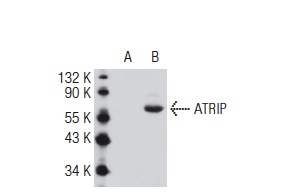
Western blot analysis of ATRIP expression in non-transfected: (A) and human ATRIP transfected: (B) 293T whole cell lysates.Application
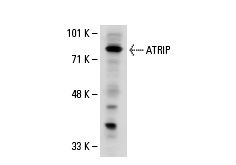
Western blot analysis of ATRIP expression in MCF7 nuclear extract.| Product Name | ATRIP Antibody (H-300) |
|---|---|
| Antibody Type | Primary Antibodies |
| Antigen Alias | epitope corresponding to amino acids 492-791 mapping at the C-terminus of ATR-Interacting Protein of human origin |
| Modification Notes | DNA damage or incomplete replication of DNA results in the inhibition of cell cycle progression at the G1 to S or the G2 to M phase transition by conserved regulatory mechanisms known as cell cycle checkpoints. Checkpoint proteins include Rad17, which is involved in regulating cell cycle progression at the G1 checkpoint as well as Chk1, Chk2, Rad1, Rad9 and Hus1, which are involved in regulating cell cycle arrest at the G2 checkpoint. In response to DNA damage, ATM and ATR kinases are important for cell cycle checkpoint response signalling. ATR-interacting protein (ATRIP), also designated ATM and Rad3-related-interacting protein, is required for checkpoint signaling after DNA damage. It is also important for ATR expression, which regulates DNA replication and damage checkpoint responses. ATRIP is a ubiquitously expressed protein that can form heterodimers with ATR. After dimerization they bind the RPA complex and are recruited to single stranded DNA. ATRIP is a nuclear protein that may also play a role in protein stabilization. |
| Clonality | Polyclonal |
|---|---|
| Isotype | IgG |
| Host Species | Rabbit |
| Tested Applications | WBIPIFELISA |
| recommended for detection of all ATR-Interacting Protein isoforms of mouse, rat and human origin by WB, IP, IF and ELISA also reactive with additional species, including equine and canine: |
|
| Species Reactivity | HumanMouseRat |
| Concentration | 1mg/ml |
| Purification | Affinity purified |
| Alternative Names | epitope corresponding to amino acids 492-791 mapping at the C-terminus of ATR-Interacting Protein of human origin |
|---|---|
| Tissue Specificity | epitope corresponding to amino acids 492-791 mapping at the C-terminus of ATR-Interacting Protein of human origin |
| Entrez Gene | 11277 |
|---|
Application
Western blot analysis of ATRIP expression in non-transfected: (A) and human ATRIP transfected: (B) 293T whole cell lysates.
Application
Western blot analysis of ATRIP expression in MCF7 nuclear extract.| Application Notes | recommended for detection of all ATR-Interacting Protein isoforms of mouse, rat and human origin by WB, IP, IF and ELISA also reactive with additional species, including equine and canine: |
|---|
| Form | Liquid |
|---|---|
| Storage Instructions | For short-term storage, store at 4° C. For long-term storage, aliquot and store at -20ºC or below. Avoid multiple freeze-thaw cycles. |
| Storage Buffer | phosphate buffered saline , pH 7.4, 150mM NaCl, 0.02% sodium azide and 50% glycerol. |


