Application
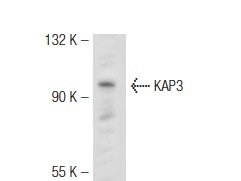
Western blot analysis of KAP3 expression in HeLa nuclear extract.| Product Name | KAP3 Antibody (M-300) |
|---|---|
| Antibody Type | Primary Antibodies |
| Antigen Alias | epitope corresponding to amino acids 494-793 mapping at the C-terminus of KAP3 of mouse origin |
| Modification Notes | The mouse kinesin superfamily-associated protein 3 (KAP3) and the human homolog KAP3A are globular proteins that function as linkers of chromosome associated proteins. The mouse gene encoding KAP3 generates an additional alternative isoform, from the insertion of a stop codon at the C-terminus, to produce a truncated KAP3 protein designated KAP3B. KAP3 was originally shown to associate with kinesin superfamily proteins, KIF3A and KIF3B, which function as an axonal motor for membranous organelle transport. The initial studies involving the human homolog of KAP3, also designated SMAP (for Small G protein GDP dissociation stimulator (Smg GDS)-associated protein), indicated that KAP3 is an adaptor protein for Smg GDS and kinesin II and a kinase substrate for tyrosine phosphorylation by v-Src. Subsequent studies have shown that SMAP/KAP3A forms ternary complexes with HCAP (human chromosome-associated polypeptide), a member of the stability of mini-chromosomes family and KIF3A/B. Once formed, these complexes assist in the association of chromosomes with the spindle and in chromosome movement during interphase. |
| Clonality | Polyclonal |
|---|---|
| Isotype | IgG |
| Host Species | Rabbit |
| Tested Applications | WBIPIFELISA |
| recommended for detection of KAP3A and KAP3B of mouse, rat and human origin by WB, IP, IF and ELISA also reactive with additional species, including equine, canine, bovine, porcine and avian: |
|
| Species Reactivity | HumanMouseRat |
| Concentration | 1mg/ml |
| Purification | Affinity purified |
| Alternative Names | epitope corresponding to amino acids 494-793 mapping at the C-terminus of KAP3 of mouse origin |
|---|---|
| Tissue Specificity | epitope corresponding to amino acids 494-793 mapping at the C-terminus of KAP3 of mouse origin |
| Entrez Gene | 22920 |
|---|
Application
Western blot analysis of KAP3 expression in HeLa nuclear extract.| Application Notes | recommended for detection of KAP3A and KAP3B of mouse, rat and human origin by WB, IP, IF and ELISA also reactive with additional species, including equine, canine, bovine, porcine and avian: |
|---|
| Form | Liquid |
|---|---|
| Storage Instructions | For short-term storage, store at 4° C. For long-term storage, aliquot and store at -20ºC or below. Avoid multiple freeze-thaw cycles. |
| Storage Buffer | phosphate buffered saline , pH 7.4, 150mM NaCl, 0.02% sodium azide and 50% glycerol. |


