Application
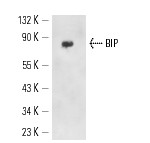
Western blot analysis of BIP expression in Arabidopsis whole cell lysate.Application
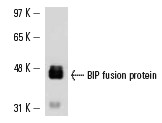
Western blot analysis of arabidopsis recombinant BIP fusion protein.| Product Name | BIP Antibody (at-95) |
|---|---|
| Antibody Type | Primary Antibodies |
| Antigen Alias | epitope corresponding to amino acids 541-635 mapping near the C-terminus of BIP of Arabidopsis thaliana origin |
| Conjugation | Agarose |
| Modification | Acetylated |
| Modification Notes | Arabidopsis growth is regulated by a wide variety of proteins that control cellular functions, such as the cell cycle, metabolism, cell signaling and survival (1). Many of these regulatory proteins control the expression of specific proteins through transcriptional regulation (2). In the nucleus, the 14-3-3 protein, which is highly conserved among plants, animals and yeast, mediates gene expression by direct protein interactions with transcriptional regulators, including the TATA-box binding protein (TBP) and the transcription factor IIB (TFIIB) (2,3). In the cytosol, the 14-3-3 protein is involved in the nutrient-sensing pathway by controlling the cleavage of target proteins (1). Also, the 14-3-3 protein is a positive regulator of the plant plasma membrane H+-ATPase (4,5). The carboxy terminal autoinhibitory domain of the H+-ATPase is displaced upon binding with the 14-3-3 protein (4,5). Other regulatory proteins include the luminal binding protein (BiP), which is a molecular chaperone whose expression is induced in response to tunicamycin and heat-shock stress (6,7). |
| Clonality | Polyclonal |
|---|---|
| Isotype | IgG |
| Host Species | Rabbit |
| Tested Applications | ELISAIFIPWB |
| recommended for detection of BIP of Arabidopsis thaliana, Nicotiana tabacum, Zea mays, and Lycopersicon esculentum origin by WB, IP, IF and ELISA.: *Optimal dilutions/concentrations should be determined by the researcher.: WB:1:100~1:200 ELISA:1:1000~5000 IP:1:20~1:100 IF:1:20~1:100 |
|
| Species Reactivity | Arabidopsis thalianaCornLycopersicon esculentumNicotiana tabacum |
| Concentration | 1mg/ml |
| Purification | Affinity purified |
| Alternative Names | epitope corresponding to amino acids 541-635 mapping near the C-terminus of BIP of Arabidopsis thaliana origin |
|---|---|
| Tissue Specificity | epitope corresponding to amino acids 541-635 mapping near the C-terminus of BIP of Arabidopsis thaliana origin |
Application
Western blot analysis of BIP expression in Arabidopsis whole cell lysate.
Application
Western blot analysis of arabidopsis recombinant BIP fusion protein.| Application Notes | recommended for detection of BIP of Arabidopsis thaliana, Nicotiana tabacum, Zea mays, and Lycopersicon esculentum origin by WB, IP, IF and ELISA.: *Optimal dilutions/concentrations should be determined by the researcher.: WB:1:100~1:200 ELISA:1:1000~5000 IP:1:20~1:100 IF:1:20~1:100 |
|---|
| Form | Liquid |
|---|---|
| Storage Instructions | For short-term storage, store at 4° C. For long-term storage, aliquot and store at -20ºC or below. Avoid multiple freeze-thaw cycles. |
| Storage Buffer | phosphate buffered saline , pH 7.4, 150mM NaCl, 0.02% sodium azide and 50% glycerol. |


