Application
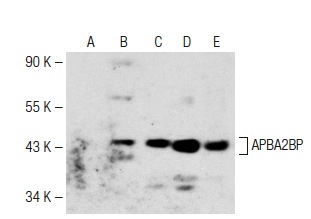
Western blot analysis of APBA2BP expression in non-transfected 293T: (A), human APBA2BP transfected 293T: (B), PC-12 (C), C2C12 (D) and HeLa (E) whole cell lysates.| Product Name | APBA2BP Antibody (E-16) |
|---|---|
| Antibody Type | Primary Antibodies |
| Antigen Alias | epitope mapping within an internal region of APBA2BP of human origin |
| Modification Notes | APBA2BP (beta-Amyloid A4 protein-binding family A member 2-binding protein), also known as NECAB3 (N-terminal EF-hand calcium-binding protein 3), NIP1, SYTIP2 or XB51, is a 396 amino acid protein that localizes to the perinuclear region of the cytoplasm and contains one calcium binding EF-hand domain and one ABM domain. Highly expressed in skeletal muscle and heart with lower expression in pancreas and brain, APBA2BP functions to interact with and inhibit the association of X11∫ with the ∫-Amyloid precursor protein, thereby allowing the formation of mature ∫-Amyloid via a non-competitive mechanism. Due to its role in ∫-Amyloid production, APBA2BP is thought to be an essential factor in ∫-Amyloid regulatory events and may contribute to the pathogenesis of Alzheimer's disease. Three isoforms of APBA2BP exist as a result of alternative splicing events. |
| Clonality | Polyclonal |
|---|---|
| Isotype | IgG |
| Host Species | Rabbit |
| Tested Applications | WBIPIFELISA |
| recommended for detection of APBA2BP of mouse, rat and human origin by WB, IP, IF and ELISA also reactive with additional species, including equine and porcine: |
|
| Species Reactivity | HumanMouseRat |
| Concentration | 1mg/ml |
| Purification | Affinity purified |
| Alternative Names | epitope mapping within an internal region of APBA2BP of human origin |
|---|---|
| Tissue Specificity | epitope mapping within an internal region of APBA2BP of human origin |
| Entrez Gene | 63941 |
|---|
Application
Western blot analysis of APBA2BP expression in non-transfected 293T: (A), human APBA2BP transfected 293T: (B), PC-12 (C), C2C12 (D) and HeLa (E) whole cell lysates.| Application Notes | recommended for detection of APBA2BP of mouse, rat and human origin by WB, IP, IF and ELISA also reactive with additional species, including equine and porcine: |
|---|
| Form | Liquid |
|---|---|
| Storage Instructions | For short-term storage, store at 4° C. For long-term storage, aliquot and store at -20ºC or below. Avoid multiple freeze-thaw cycles. |
| Storage Buffer | phosphate buffered saline , pH 7.4, 150mM NaCl, 0.02% sodium azide and 50% glycerol. |


