Application
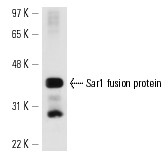
Western blot analysis of yeast recombinant Sar1 fusion protein.| Product Name | Sar1 Antibody (y-80) |
|---|---|
| Antibody Type | Primary Antibodies |
| Antigen Alias | epitope corresponding to amino acids 41-120 mapping within an internal region of Sar1 of Saccharomyces cerevisiae origin |
| Modification Notes | There are a number of components that are involved in the secretory pathway of Saccharomyces cerevisiae, which are collectively also known as the SEC gene products (1). Among these proteins, the yeast SAR1 gene encodes a low-molecular-weight GTPase that is essential for the formation of transport vesicles from the endoplasmic reticulum (ER) (2). Vesicular traffic within the early secretory pathway is mediated by COPI- and COPII-coated vesicles (4). The COPII vesicle coat protein promotes the formation of ER derived transport vesicles that carry secretory proteins to the Golgi complex in yeast (3,4). This coat protein consists of Sar1, the Sec23 protein complex containing Sec23 and Sec24, and the Sec13 protein complex containing Sec13 and p150 (3,5). p150 is encoded by the gene SEC31, which was intially isolated in a genetic screen for mutations that accumulate unprocessed forms of the secretory protein alpha-factor (3). |
| Clonality | Polyclonal |
|---|---|
| Isotype | IgG |
| Host Species | Rabbit |
| Tested Applications | WBIPELISA |
| recommended for detection of Sar1 of Saccaromyces cerevisiae origin by WB, IP and ELISA: |
|
| Species Reactivity | HumanMouseRat |
| Concentration | 1mg/ml |
| Purification | Affinity purified |
| Alternative Names | epitope corresponding to amino acids 41-120 mapping within an internal region of Sar1 of Saccharomyces cerevisiae origin |
|---|---|
| Tissue Specificity | epitope corresponding to amino acids 41-120 mapping within an internal region of Sar1 of Saccharomyces cerevisiae origin |
Application
Western blot analysis of yeast recombinant Sar1 fusion protein.| Application Notes | recommended for detection of Sar1 of Saccaromyces cerevisiae origin by WB, IP and ELISA: |
|---|
| Form | Liquid |
|---|---|
| Storage Instructions | For short-term storage, store at 4° C. For long-term storage, aliquot and store at -20ºC or below. Avoid multiple freeze-thaw cycles. |
| Storage Buffer | phosphate buffered saline , pH 7.4, 150mM NaCl, 0.02% sodium azide and 50% glycerol. |


