Application
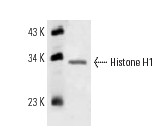
Western blot analysis of Histone H1 expression in LNCaP whole cell lysate.Application
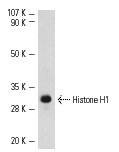
Western blot analysis of recombinant Histone H1.| Product Name | Histone H1 Antibody (FL-219) |
|---|---|
| Antibody Type | Primary Antibodies |
| Antigen Alias | epitope corresponding to amino acids 1-219 representing full length Histone H1 of human origin |
| Modification Notes | Eukaryotic histones are basic and water soluble nuclear proteins that form hetero-octameric nucleosome particles by wrapping 146 base pairs of DNA in a left-handed super-helical turn sequentially to form chromosomal fiber. Two molecules of each of the four core histones (H2A, H2B, H3, and H4) form the octamer; formed of two H2A-H2B dimers and two H3-H4 dimers, forming two nearly symmetrical halves by tertiary structure. Over 80% of nucleosomes contain the linker Histone H1, derived from an intronless gene, that interacts with linker DNA between nucleosomes and mediates compaction into higher order chromatin. Histones are subject to posttranslational modification by enzymes primarily on their N-terminal tails, but also in their globular domains. Such modifications include methylation, citrullination, acetylation, phosphorylation, sumoylation, ubiquitination and ADP-ribosylation. |
| Clonality | Polyclonal |
|---|---|
| Isotype | IgG |
| Host Species | Rabbit |
| Tested Applications | WBIPIFELISA |
| recommended for detection of all Histone H1 isoforms of broad mammalian and Xenopus origin by WB, IP, IF and ELISA also reactive with additional species, including equine and bovine: |
|
| Species Reactivity | HumanMouseRat |
| Concentration | 1mg/ml |
| Purification | Affinity purified |
| Alternative Names | epitope corresponding to amino acids 1-219 representing full length Histone H1 of human origin |
|---|---|
| Tissue Specificity | epitope corresponding to amino acids 1-219 representing full length Histone H1 of human origin |
Application
Western blot analysis of Histone H1 expression in LNCaP whole cell lysate.
Application
Western blot analysis of recombinant Histone H1.| Application Notes | recommended for detection of all Histone H1 isoforms of broad mammalian and Xenopus origin by WB, IP, IF and ELISA also reactive with additional species, including equine and bovine: |
|---|
| Form | Liquid |
|---|---|
| Storage Instructions | For short-term storage, store at 4° C. For long-term storage, aliquot and store at -20ºC or below. Avoid multiple freeze-thaw cycles. |
| Storage Buffer | phosphate buffered saline , pH 7.4, 150mM NaCl, 0.02% sodium azide and 50% glycerol. |


