Application
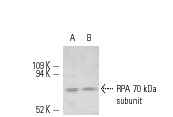
Western blot analysis of RPA 70 kDa subunit expression in SW480 (A) and K-562 (B) nuclear extracts.| Product Name | RPA 70 kDa subunit Antibody (H-300) |
|---|---|
| Antibody Type | Primary Antibodies |
| Antigen Alias | epitope corresponding to amino acids 317-616 mapping at the C-terminus of RPA 70 kDa subunit of human origin |
| Modification Notes | The single-stranded-DNA-binding proteins (SSBs) are essential for DNA function in prokaryotic and eukaryotic cells, mitochondria, phages and viruses. Replication protein A (RPA), a highly conserved eukaryotic protein, is a heterotrimeric SSB. RPA plays an important role in DNA replication, recombination and repair. The binding of human RPA (hRPA) to DNA involves molecular polarity in which initial hRPA binding occurs on the 5' side of an ssDNA substrate and then extends in the 3' direction to create a stably bound hRPA. RPA is a major damage-recognition protein involved in the early stages of nucleotide excision repair. It can also play a role in telomere maintenance. The RPA 70 kDa subunit binds to ssDNA and mediates interactions with many cellular and viral proteins. The DNA binding domain lies in the middle of RPA 70 kDa subunit and comprises two structurally homologous subdomains oriented in tandem. RPA contains a conserved four cysteine-type zinc-finger motif, which mediates the transition of RPA-ssDNA interaction to a stable RPA-ssDNA complex in a redox-dependent manner. |
| Clonality | Polyclonal |
|---|---|
| Isotype | IgG |
| Host Species | Rabbit |
| Tested Applications | WBIPIFELISAGSChIP |
| recommended for detection of RPA 70 kDa subunit of mouse, rat and human origin by WB, IP, IF and ELISA also reactive with additional species, including equine, canine, bovine and porcine: |
|
| Species Reactivity | HumanMouseRat |
| Concentration | 1mg/ml |
| Purification | Affinity purified |
| Alternative Names | epitope corresponding to amino acids 317-616 mapping at the C-terminus of RPA 70 kDa subunit of human origin |
|---|---|
| Tissue Specificity | epitope corresponding to amino acids 317-616 mapping at the C-terminus of RPA 70 kDa subunit of human origin |
| Entrez Gene | 6117 |
|---|
Application
Western blot analysis of RPA 70 kDa subunit expression in SW480 (A) and K-562 (B) nuclear extracts.| Application Notes | recommended for detection of RPA 70 kDa subunit of mouse, rat and human origin by WB, IP, IF and ELISA also reactive with additional species, including equine, canine, bovine and porcine: |
|---|
| Form | Liquid |
|---|---|
| Storage Instructions | For short-term storage, store at 4° C. For long-term storage, aliquot and store at -20ºC or below. Avoid multiple freeze-thaw cycles. |
| Storage Buffer | phosphate buffered saline , pH 7.4, 150mM NaCl, 0.02% sodium azide and 50% glycerol. |


