Application
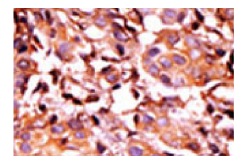
Immunoperoxidase staining of formalin fixed, paraffin-embedded human cancer tissue showing cytoplasmic staining.| Product Name | p-IL-1RI Antibody (Tyr 496) |
|---|---|
| Antibody Type | Primary Antibodies |
| Antigen Alias | recommended for detection of Tyr 496 phosphorylated IL-1RI of human origin by WB, IP, IF, IHC(P) and ELISA |
| Modification | Phosphoralated |
| Modification Notes | Three structurally related ligands for IL-1Rs have been described. These include two agonists, IL-1å and IL-1∫, and a specific receptor antagonist, IL-1Rå. Among the activities regulated by IL-1 are fever, acute phase responses, degradation of connective tissue and immunostimulatory activities. The IL-1Rå molecule also binds specifically to IL-1 receptors (IL-1Rs), but fails to initiate intracellular responses. Two distinct IL-1Rs have been identified, each of which belongs to the Ig superfamily and is widely expressed in a broad range of cells and tissues. Although many cell types co-express type I and type II receptors, there is no evidence that these constitute subunits of a single complex. The type II receptor has a short 29 amino acid cytoplasmic domain that does not seem sufficient for signaling, while in fact there is considerable evidence arguing that IL-1 signals exclusively through the type I IL-1R. Human IL-1RI may be phosphorylated on Tyr 496. |
| Clonality | Polyclonal |
|---|---|
| Isotype | IgG |
| Host Species | Rabbit |
| Tested Applications | WBIPIFIHCELISA |
| WB:1:500~1:2000 IP:1:100~1:500 IF:1:200~1:500 IHC:1:50~1:200 Notes:Optimal dilutions/concentrations should be determined by the researcher. |
|
| Species Reactivity | HumanMouseRat |
| Concentration | 1mg/ml |
| Purification | Affinity purified |
| Alternative Names | recommended for detection of Tyr 496 phosphorylated IL-1RI of human origin by WB IP IF IHC(P) and ELISA |
|---|---|
| Tissue Specificity | recommended for detection of Tyr 496 phosphorylated IL-1RI of human origin by WB, IP, IF, IHC(P) and ELISA |
| Entrez Gene | 3554 |
|---|
Application
Immunoperoxidase staining of formalin fixed, paraffin-embedded human cancer tissue showing cytoplasmic staining.| Application Notes | WB:1:500~1:2000 IP:1:100~1:500 IF:1:200~1:500 IHC:1:50~1:200 Notes:Optimal dilutions/concentrations should be determined by the researcher. |
|---|
| Form | Liquid |
|---|---|
| Storage Instructions | For short-term storage, store at 4° C. For long-term storage, aliquot and store at -20ºC or below. Avoid multiple freeze-thaw cycles. |
| Storage Buffer | phosphate buffered saline , pH 7.4, 150mM NaCl, 0.02% sodium azide and 50% glycerol. |


