Application
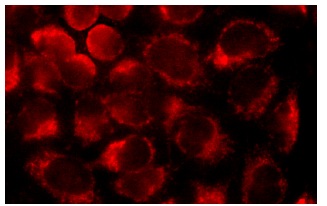
Immunofluorescence staining of methanol-fixed HeLa cells showing cytoplasmic localization.Application
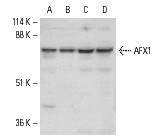
Western blot analysis of AFX1 expression in HeLa (A), MM-142 (B), LADMAC (C) and c4 (D) whole cell lysates.| Product Name | AFX1 Antibody (H-80) |
|---|---|
| Antibody Type | Primary Antibodies |
| Antigen Alias | epitope corresponding to amino acids 386-465 of AFX1 of human origin |
| Modification Notes | FKHR (for forkhead in rhabdomyosarcoma), FKHRL1, and AFX1 are members of a subfamily of the forkhead family of transcription factors. AFX1, also known as FoxO4, is expressed in a wide variety of tissues and, like other FKHR proteins, AFX1 contains a single forkhead domain and serine-proline-rich region, which mediate DNA binding. AFX1-mediated transcriptional activation is regulated by the serine/threonine kinase Akt1, which phosphorylates AFX1 and in turn, sequesters AFX1 in the cytosol, thereby blocking nuclear localization and DNA binding. Genetic mutations in FKHR genes, including the t(2;13) and t(1;3) translocations, are commonly found in alveolar rhabdomyosarcomas. Additionally, the t(x;11) translocation of the AFX1 gene, which involves the fusion of a serine-proline-rich sequence of AFX1 to the carboxy terminus of a truncated MLL, results in acute lymphocytic leukemia. |
| Clonality | Polyclonal |
|---|---|
| Isotype | IgG |
| Host Species | Rabbit |
| Tested Applications | WBIPIFELISAGSChIP |
| recommended for detection of AFX1 of mouse, rat and human origin by WB, IP, IF and ELISA also reactive with additional species, including equine and canine: |
|
| Species Reactivity | HumanMouseRat |
| Concentration | 1mg/ml |
| Purification | Affinity purified |
| Alternative Names | epitope corresponding to amino acids 386-465 of AFX1 of human origin |
|---|---|
| Tissue Specificity | epitope corresponding to amino acids 386-465 of AFX1 of human origin |
| Entrez Gene | 4303 |
|---|
Application
Immunofluorescence staining of methanol-fixed HeLa cells showing cytoplasmic localization.
Application
Western blot analysis of AFX1 expression in HeLa (A), MM-142 (B), LADMAC (C) and c4 (D) whole cell lysates.| Application Notes | recommended for detection of AFX1 of mouse, rat and human origin by WB, IP, IF and ELISA also reactive with additional species, including equine and canine: |
|---|
| Form | Liquid |
|---|---|
| Storage Instructions | For short-term storage, store at 4° C. For long-term storage, aliquot and store at -20ºC or below. Avoid multiple freeze-thaw cycles. |
| Storage Buffer | phosphate buffered saline , pH 7.4, 150mM NaCl, 0.02% sodium azide and 50% glycerol. |


