Application
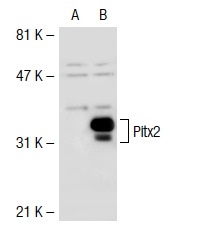
Western blot analysis of Pitx2 expression in non-transfected: (A) and human Pitx2 transfected: (B) 293T whole cell lysates.| Product Name | Pitx2 Antibody (H-80) |
|---|---|
| Antibody Type | Primary Antibodies |
| Antigen Alias | epitope corresponding to amino acids 1-80 mapping at the N-terminus of Pitx2B of human origin |
| Modification Notes | Pitx1 and Pitx2 are highly homologous, bicoid-related transcription factors (1,2). Pitx1 is a bicoid-related homeodomain factor that exhibits preferential expression in the hindlimb, as well as expression in the developing anterior pituitary gland and first branchial arch (3). Deletion of the Pitx1 locus results in decreased distal expression of the hindlimb-specific marker, the T-box factor (Tbx4) (3–5). Pitx1 may modulate morphogenesis, growth and patterning of a specific hindlimb region, and serves as a component of the variables that influence morphological and growth distinctions in forelimb and hindlimb identity (3,4). Pitx2 was initially identified as the gene responsible for human Rieger syndrome, an autosomal dominant condition that causes developmental abnormalities (1). Pitx2 is a transcription factor that regulates cardiac positioning and pituitary and tooth morphogenesis (1). Pitx2 also regulates lung symmetry by encoding “leftness” of the lung (1). Pitx2 is asymmetrically expressed in the left lateral-plate mesoderm, and mutant mice with laterality defects show altered patterns of Pitx2 expression that correlate with changes in the visceral symmetry (1). The genes which encode Pitx1 and Pitx2 map to human chromosomes 5q31 and 4q25-q26, respectively (6,7). |
| Clonality | Polyclonal |
|---|---|
| Isotype | IgG |
| Host Species | Rabbit |
| Tested Applications | WBIPIFELISAGSChIP |
| recommended for detection of Pitx2B, and, to a lesser extent, Pitx2A and Pitx2C of mouse, rat and human origin by WB, IP, IF and ELISA also reactive with additional species, including equine and canine: |
|
| Species Reactivity | HumanMouseRat |
| Concentration | 1mg/ml |
| Purification | Affinity purified |
| Alternative Names | epitope corresponding to amino acids 1-80 mapping at the N-terminus of Pitx2B of human origin |
|---|---|
| Tissue Specificity | epitope corresponding to amino acids 1-80 mapping at the N-terminus of Pitx2B of human origin |
| Entrez Gene | 5308 |
|---|
Application
Western blot analysis of Pitx2 expression in non-transfected: (A) and human Pitx2 transfected: (B) 293T whole cell lysates.| Application Notes | recommended for detection of Pitx2B, and, to a lesser extent, Pitx2A and Pitx2C of mouse, rat and human origin by WB, IP, IF and ELISA also reactive with additional species, including equine and canine: |
|---|
| Form | Liquid |
|---|---|
| Storage Instructions | For short-term storage, store at 4° C. For long-term storage, aliquot and store at -20ºC or below. Avoid multiple freeze-thaw cycles. |
| Storage Buffer | phosphate buffered saline , pH 7.4, 150mM NaCl, 0.02% sodium azide and 50% glycerol. |


