Application
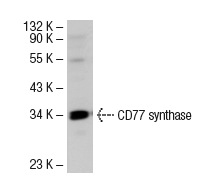
Western blot analysis of CD77 synthase expression in Daudi whole cell lysate.| Product Name | CD77 synthase Antibody (H-160) |
|---|---|
| Antibody Type | Primary Antibodies |
| Antigen Alias | epitope corresponding to amino acids 194-353 mapping at the C-terminus of CD77 synthase of human origin |
| Modification Notes | Expression of CD77, also called Gb3, sensitizes a cell to verotoxins, causing cellular injury that can lead to disease. Therefore, the complex regulation of CD77 biosynthesis and the activity of the enzymes involved, such as CD77 synthase, can be studied by compared gene expression between toxin-sensitive and insensitive tissues and cell lines. The highest tissue expression of CD77 synthase occurs in the kidney, mesenteric lymph node, spleen, and brain. Burkitt leukemia cells express very high levels of CD77 as well as CD77 synthase, and are sensitive to verotoxin induced apoptosis. These megakaryoblasts then never mature, leading to the arrest of platelet generation in the bone marrow, which may cause thrombocytopenia, a symptom associated with various hemorrhagic conditions. |
| Clonality | Polyclonal |
|---|---|
| Isotype | IgG |
| Host Species | Rabbit |
| Tested Applications | WBIPIFELISA |
| recommended for detection of CD77 synthase of mouse, rat and human origin by WB, IP, IF and ELISA also reactive with additional species, including canine and porcine: |
|
| Species Reactivity | HumanMouseRat |
| Concentration | 1mg/ml |
| Purification | Affinity purified |
| Alternative Names | epitope corresponding to amino acids 194-353 mapping at the C-terminus of CD77 synthase of human origin |
|---|---|
| Tissue Specificity | epitope corresponding to amino acids 194-353 mapping at the C-terminus of CD77 synthase of human origin |
| Entrez Gene | 53947 |
|---|
Application
Western blot analysis of CD77 synthase expression in Daudi whole cell lysate.| Application Notes | recommended for detection of CD77 synthase of mouse, rat and human origin by WB, IP, IF and ELISA also reactive with additional species, including canine and porcine: |
|---|
| Form | Liquid |
|---|---|
| Storage Instructions | For short-term storage, store at 4° C. For long-term storage, aliquot and store at -20ºC or below. Avoid multiple freeze-thaw cycles. |
| Storage Buffer | phosphate buffered saline , pH 7.4, 150mM NaCl, 0.02% sodium azide and 50% glycerol. |


