Application
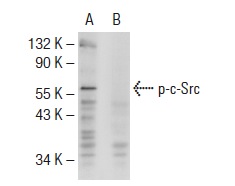
Western blot analysis of c-Src phosphorylation in untreated (A) and lambda protein phosphatase treated (B) Jurkat whole cell lysates.| Product Name | p-c-Src Antibody (Thr 420) |
|---|---|
| Antibody Type | Primary Antibodies |
| Antigen Alias | epitope corresponding to phosphorylated Thr 420 of c-Src of human origin |
| Modification | Phosphoralated |
| Modification Notes | The major translational products of the Src gene family are membrane-associated tyrosine protein kinases that lack transmembrane and external amino acid sequences. By virtue of their common structural motifs, the Src family is composed of nine members in vertebrates, including c-Src, c-Yes, Fgr, Yrk, Fyn, Lyn, Hck, Lck and Blk. Src family kinases, which contain an amino-terminal cell membrane anchor followed by SH3 and SH2 domains, transduce signals that are involved in the control of a variety of cellular processes, including proliferation, differentiation, motility and adhesion. Src family members are normally maintained in an inactive state and can be activated transiently during cellular events such as mitosis. Different subcellular locations of Src family kinases may be important for the regulation of specific cellular processes, such as mitogenesis, cytoskeletal organization and membrane trafficking. c-Src (also designated pp60Src, Src p60 and proto-oncogene tyrosine protein kinase Src) is expressed in a broad range of tissue and cell types, although the highest levels of c-Src are detected in neuronal tissues and platelets. c-Src may play a role in events associated with both neuronal differentiation and maintenance of mature neuronal cell functions. |
| Clonality | Polyclonal |
|---|---|
| Isotype | IgG |
| Host Species | Rabbit |
| Tested Applications | WBIPIFELISA |
| recommended for detection of Thr 420 phosphorylated c-Src of mouse, rat, human and Xenopus origin by WB, IP, IF and ELISA also reactive with additional species, including equine, canine, bovine, porcine and avian: |
|
| Species Reactivity | HumanMouseRat |
| Concentration | 1mg/ml |
| Purification | Affinity purified |
| Alternative Names | epitope corresponding to phosphorylated Thr 420 of c-Src of human origin |
|---|---|
| Tissue Specificity | epitope corresponding to phosphorylated Thr 420 of c-Src of human origin |
Application
Western blot analysis of c-Src phosphorylation in untreated (A) and lambda protein phosphatase treated (B) Jurkat whole cell lysates.| Application Notes | recommended for detection of Thr 420 phosphorylated c-Src of mouse, rat, human and Xenopus origin by WB, IP, IF and ELISA also reactive with additional species, including equine, canine, bovine, porcine and avian: |
|---|
| Form | Liquid |
|---|---|
| Storage Instructions | For short-term storage, store at 4° C. For long-term storage, aliquot and store at -20ºC or below. Avoid multiple freeze-thaw cycles. |
| Storage Buffer | phosphate buffered saline , pH 7.4, 150mM NaCl, 0.02% sodium azide and 50% glycerol. |


