Application
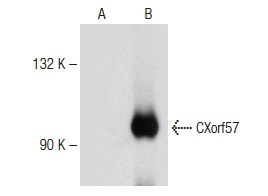
Western blot analysis of CXorf57 expression in non-transfected: (A) and human CXorf57 transfected: (B) 293T whole cell lysates.| Product Name | CXorf57 Antibody (E-20) |
|---|---|
| Antibody Type | Primary Antibodies |
| Antigen Alias | epitope mapping within an internal region of CXorf57 of human origin |
| Modification Notes | The X and Y chromosomes are the human sex chromosomes. Chromosome X consists of about 153 million base pairs and nearly 1,000 genes. The combination of an X and Y chromosome lead to normal male development while two copies of X lead to normal female development. There are a number of conditions related to an unsual number and combination of sex chromosomes being inherited. More than one copy of the X chromosome with a Y chromosome causes Klinefelter's syndrome. A single copy of X alone leads to Turner's syndrome. More than 2 copies of the X chromosome, in the absence of a Y chromosome, is known as Triple X syndrome. Color blindness, hemophilia, and Duchenne muscular dystrophy are well known X chromosome-linked conditions which affect males more frequently as males carry a single X chromosome. The CXorf57 gene product has been provisionally designated CXorf57 pending further characterization. |
| Clonality | Polyclonal |
|---|---|
| Isotype | IgG |
| Host Species | Rabbit |
| Tested Applications | WBIPIFELISA |
| recommended for detection of CXorf57 of human origin, D330045A20Rik of mouse origin and the corresponding rat homolog by WB, IP, IF and ELISA also reactive with additional species, including equine, canine and porcine: |
|
| Species Reactivity | HumanMouseRat |
| Concentration | 1mg/ml |
| Purification | Affinity purified |
| Alternative Names | epitope mapping within an internal region of CXorf57 of human origin |
|---|---|
| Tissue Specificity | epitope mapping within an internal region of CXorf57 of human origin |
| Entrez Gene | 55086 |
|---|
Application
Western blot analysis of CXorf57 expression in non-transfected: (A) and human CXorf57 transfected: (B) 293T whole cell lysates.| Application Notes | recommended for detection of CXorf57 of human origin, D330045A20Rik of mouse origin and the corresponding rat homolog by WB, IP, IF and ELISA also reactive with additional species, including equine, canine and porcine: |
|---|
| Form | Liquid |
|---|---|
| Storage Instructions | For short-term storage, store at 4° C. For long-term storage, aliquot and store at -20ºC or below. Avoid multiple freeze-thaw cycles. |
| Storage Buffer | phosphate buffered saline , pH 7.4, 150mM NaCl, 0.02% sodium azide and 50% glycerol. |


