Application
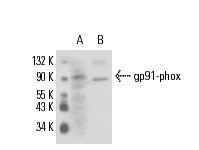
Western blot analysis of gp91-phox expression in mouse lymphnode (A) and rat pituitary (B) tissue extracts.| Product Name | gp91-phox Antibody (H-60) |
|---|---|
| Antibody Type | Primary Antibodies |
| Antigen Alias | epitope corresponding to amino acids 231-290 mapping to an internal region of gp91-phox of human origin |
| Modification Notes | Mox1 and the glycoprotein gp91-phox are largely related proteins that are essential components of the NADPH oxidase. The superoxide-generating NADPH oxidase is present in phagocytes, neuroepithelial bodies, vascular smooth muscle cells and endothelial cells. It includes a membrane-bound flavocytochrome containing two subunits, gp91-phox and p22-phox, and the cytosolic proteins p47-phox and p67-phox. During activation of the NADPH oxidase, p47-phox and p67-phox migrate to the plasma membrane, where they associate with the flavocytochrome cytochrome b558 to form the active enzyme complex. The p22- and gp91-phox subunits also function as surface O2 sensors that initiate cellular signaling in response to hypoxic conditions. Mox1 and gp91 contain identical C-terminal sequence identity, yet they have distinct expression patterns. gp91-phox is expressed in eosinophils, neutro-phils, monocytes and B-lymphocytes, whereas Mox1 is predominantly detected in the colon, and low expression is also detected in the uterus and prostate. Mox1 is also upregulated in vascular smooth-muscle cells in response to PDGF stimulation, which collectively indicates that Mox1 may function analogously to gp91-phox, yet regulate the NADPH superoxide production in non-phagocytic cells. |
| Clonality | Polyclonal |
|---|---|
| Isotype | IgG |
| Host Species | Rabbit |
| Tested Applications | WBIPIFELISA |
| recommended for detection of gp91-phox of human and, to a lesser extent, mouse and rat origin by WB, IP, IF and ELISA: |
|
| Species Reactivity | HumanMouseRat |
| Concentration | 1mg/ml |
| Purification | Affinity purified |
| Alternative Names | epitope corresponding to amino acids 231-290 mapping to an internal region of gp91-phox of human origin |
|---|---|
| Tissue Specificity | epitope corresponding to amino acids 231-290 mapping to an internal region of gp91-phox of human origin |
| Entrez Gene | 1536 |
|---|
Application
Western blot analysis of gp91-phox expression in mouse lymphnode (A) and rat pituitary (B) tissue extracts.| Application Notes | recommended for detection of gp91-phox of human and, to a lesser extent, mouse and rat origin by WB, IP, IF and ELISA: |
|---|
| Form | Liquid |
|---|---|
| Storage Instructions | For short-term storage, store at 4° C. For long-term storage, aliquot and store at -20ºC or below. Avoid multiple freeze-thaw cycles. |
| Storage Buffer | phosphate buffered saline , pH 7.4, 150mM NaCl, 0.02% sodium azide and 50% glycerol. |


