Application
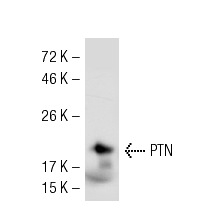
Western blot analysis of PTN expression in rat brain tissue extract.| Product Name | PTN Antibody (H-75) |
|---|---|
| Antibody Type | Primary Antibodies |
| Antigen Alias | epitope corresponding to amino acids 94-168 mapping at the C-terminus of pleiotrophin (PTN) of human origin |
| Modification Notes | Pleiotrophin (PTN) and midkine (MK) comprise a family of structurally related, developmentally regulated genes. Human PTN is synthesized as a 168 amino acid precursor which is subsequently cleaved to generate a 136 amino acid protein. Human PTN is approximately 50% identical to human MK, with conservation of all 10 cysteines. Cells reported to express PTN include osteoblasts, chondrocytes, fibroblasts, astrocytes, oligodendroglia, Schwann cells, neurons, pituicytes and Leydig cells. PTN is a heparin-binding growth factor that functions as a weak mitogen and promotes neurite outgrowth from embryonic brain neurons. PTN is expressed at high levels in many tissues during fetal development but becomes restricted to the brain in adult animals. |
| Clonality | Polyclonal |
|---|---|
| Isotype | IgG |
| Host Species | Rabbit |
| Tested Applications | WBIPIFELISA |
| recommended for detection of PTN of mouse, rat and human origin by WB, IP, IF and ELISA also reactive with additional species, including equine, canine, bovine, porcine and avian: |
|
| Species Reactivity | HumanMouseRat |
| Concentration | 1mg/ml |
| Purification | Affinity purified |
| Alternative Names | epitope corresponding to amino acids 94-168 mapping at the C-terminus of pleiotrophin (PTN) of human origin |
|---|---|
| Tissue Specificity | epitope corresponding to amino acids 94-168 mapping at the C-terminus of pleiotrophin (PTN) of human origin |
| Entrez Gene | 5764 |
|---|
Application
Western blot analysis of PTN expression in rat brain tissue extract.| Application Notes | recommended for detection of PTN of mouse, rat and human origin by WB, IP, IF and ELISA also reactive with additional species, including equine, canine, bovine, porcine and avian: |
|---|
| Form | Liquid |
|---|---|
| Storage Instructions | For short-term storage, store at 4° C. For long-term storage, aliquot and store at -20ºC or below. Avoid multiple freeze-thaw cycles. |
| Storage Buffer | phosphate buffered saline , pH 7.4, 150mM NaCl, 0.02% sodium azide and 50% glycerol. |


