Application
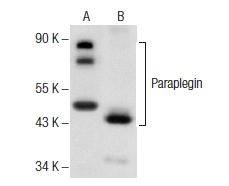
Western blot analysis of Paraplegin expression in rat skeletal muscle tissue extract (A) and human recombinant Paraplegin fusion protein (B).| Product Name | Paraplegin Antibody (H-180) |
|---|---|
| Antibody Type | Primary Antibodies |
| Modification Notes | Paraplegin, also known as SPG7 (spastic paraplegia protein 7), CAR, CMAR or PGN, is a 795 amino acid metalloprotease that is a member of the AAA protein family. Localized to the mitochrondrial membrane and expressed throughout the body, Paraplegin is a multi-pass membrane protein that is thought to be involved in signal transduction and chaperone-like activities in the mitochrondria. Defects in the gene encoding Paraplegin are the cause of spastic paraplegia type 7 (SPG7), a form of autosomal recessive hereditary spastic paraplegia (AR-HSP). HSPs are degenerative spinal cord disorders that are characterized by muscle spasms, stiffness in the legs and, in some cases, incontinence. Recent studies suggest that SPG7 may be a mitochondrial-based disease, as mutations in the Paraplegin gene lead to ragged-red fibers, oxidase-negative fibers and intense succinate dehydrogenase-stained areas of the mitochrondria. These mitochondrial dysfunctions lead to axonal degeneration and impaired axonal transport, thus causing the neurodegeneration seen in HSPs. |
| Clonality | Polyclonal |
|---|---|
| Isotype | IgG |
| Host Species | Rabbit |
| Tested Applications | WBIPIFELISA |
| recommended for detection of Paraplegin of mouse, rat and human origin by WB, IP, IF and ELISA | |
| Species Reactivity | HumanMouseRat |
| Concentration | 1mg/ml |
| Purification | Affinity purified |
| Alternative Names | epitope corresponding to amino acids 131-310 mapping within an internal region of Paraplegin of human origin |
|---|---|
| Tissue Specificity | epitope corresponding to amino acids 131-310 mapping within an internal region of Paraplegin of human origin |
| Entrez Gene | 6687 |
|---|
Application
Western blot analysis of Paraplegin expression in rat skeletal muscle tissue extract (A) and human recombinant Paraplegin fusion protein (B).| Application Notes | recommended for detection of Paraplegin of mouse, rat and human origin by WB, IP, IF and ELISA |
|---|
| Form | Liquid |
|---|---|
| Storage Instructions | For short-term storage, store at 4° C. For long-term storage, aliquot and store at -20ºC or below. Avoid multiple freeze-thaw cycles. |
| Storage Buffer | phosphate buffered saline , pH 7.4, 150mM NaCl, 0.02% sodium azide and 50% glycerol. |


