Application
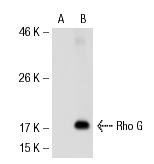
Western blot analysis of Rho G expression in non-transfected: (A) and mouse Rho G transfected: (B) 293T whole cell lysates.Application
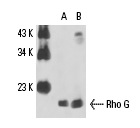
Western blot analysis of Rho G expression in MDA-MB-231 (A) and Rat2 (B) whole cell lysates.| Product Name | Rho G Antibody (C-20) |
|---|---|
| Antibody Type | Primary Antibodies |
| Antigen Alias | epitope mapping at the C-terminus of Rho G of human origin |
| Modification Notes | The Ras p21 family of guanine nucleotide proteins has been widely studied in view of its apparent role in signal transduction pathways and high frequency of mutations in human malignancies. It is now clear, however, that the Ras proteins (H-, K- and N-Ras p21) are members of a much larger superfamily of related proteins. Six members of this family, Rap 1A, Rap 1B, Rap 2, R-Ras, Ral A and Ral B, exhibit approximately 50% amino acid homology to Ras. The six mammalian Rho proteins (Rho A, B, C, G, 7 and 8) are approximately 30% homologous to Ras and are expressed in a wide range of cell types. Both Ras p21 and Rho p21, as well as other members of the Ras superfamily, contain a carboxy-terminal CAAX sequence (C, cysteine; A, aliphatic amino acid; X, any amino acid) which in the case of Ras has been shown to be essential for correct localization and function. |
| Clonality | Polyclonal |
|---|---|
| Isotype | IgG |
| Host Species | Rabbit |
| Tested Applications | WBIPIFELISA |
| recommended for detection of Rho G of mouse, rat, human and hamster origin by WB, IP, IF and ELISA also reactive with additional species, including equine, canine, bovine and porcine: |
|
| Species Reactivity | HumanMouseRat |
| Concentration | 1mg/ml |
| Purification | Affinity purified |
| Alternative Names | epitope mapping at the C-terminus of Rho G of human origin |
|---|---|
| Tissue Specificity | epitope mapping at the C-terminus of Rho G of human origin |
| Entrez Gene | 391 |
|---|
Application
Western blot analysis of Rho G expression in non-transfected: (A) and mouse Rho G transfected: (B) 293T whole cell lysates.
Application
Western blot analysis of Rho G expression in MDA-MB-231 (A) and Rat2 (B) whole cell lysates.| Application Notes | recommended for detection of Rho G of mouse, rat, human and hamster origin by WB, IP, IF and ELISA also reactive with additional species, including equine, canine, bovine and porcine: |
|---|
| Form | Liquid |
|---|---|
| Storage Instructions | For short-term storage, store at 4° C. For long-term storage, aliquot and store at -20ºC or below. Avoid multiple freeze-thaw cycles. |
| Storage Buffer | phosphate buffered saline , pH 7.4, 150mM NaCl, 0.02% sodium azide and 50% glycerol. |


