Application
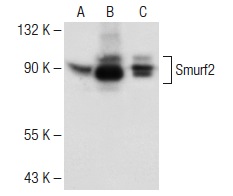
Western blot analysis of Smurf2 expression in U-2 OS (A), WI 38 (B) and DU 145 (C) whole cell lysates.Application
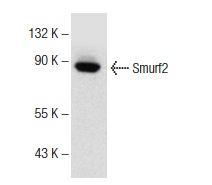
Western blot analysis of Smurf2 expression in WI 38 whole cell lysate.| Product Name | Smurf2 Antibody (H-50) |
|---|---|
| Antibody Type | Primary Antibodies |
| Modification Notes | Smurf1 and Smurf2 (SMAD ubiquitination regulatory factor-1 and 2) are members of the Hect family of proteins, which also includes the ubiquitin (Ub) E3-type ligases Nedd3 and E6-AP (1,2). E3 ligases are involved in the enzymatic reactions of the Ub conjugating pathway, which targets proteins for degradation by the 26S proteasome (3). Within the Ub pathway, the E3 ligases specifically catalyze the transfer of Ub from the Ub-conjugating enzymes to the individual protein substrate (4). As an E3 ligase, Smurf1 selectively interacts with receptor-regulated SMADs specific to the BMP pathway in order to trigger their ubiquitination and degradation (1). Smurf2 interacts with receptor-activated Smads (R-Smads), including Smad1, Smad2, and Smad3, but not Smad4 (5). Although Smurf2 localizes to the nucleus, binding to Smad7 induces its export and its recruitment to the activated TGF∫ receptor, where it causes degradation of Smad7 (6). |
| Clonality | Polyclonal |
|---|---|
| Isotype | IgG |
| Host Species | Rabbit |
| Tested Applications | WBIPIFELISA |
| recommended for detection of Smurf2 of mouse, rat and human origin by WB, IP, IF and ELISA also reactive with additional species, including canine, bovine and avian | |
| Species Reactivity | HumanMouseRat |
| Concentration | 1mg/ml |
| Purification | Affinity purified |
| Alternative Names | epitope corresponding to amino acids 204-253 mapping to an internal region of Smurf2 of human origin |
|---|---|
| Tissue Specificity | epitope corresponding to amino acids 204-253 mapping to an internal region of Smurf2 of human origin |
| Entrez Gene | 64750 |
|---|
Application
Western blot analysis of Smurf2 expression in U-2 OS (A), WI 38 (B) and DU 145 (C) whole cell lysates.
Application
Western blot analysis of Smurf2 expression in WI 38 whole cell lysate.| Application Notes | recommended for detection of Smurf2 of mouse, rat and human origin by WB, IP, IF and ELISA also reactive with additional species, including canine, bovine and avian |
|---|
| Form | Liquid |
|---|---|
| Storage Instructions | For short-term storage, store at 4° C. For long-term storage, aliquot and store at -20ºC or below. Avoid multiple freeze-thaw cycles. |
| Storage Buffer | phosphate buffered saline , pH 7.4, 150mM NaCl, 0.02% sodium azide and 50% glycerol. |


