Application
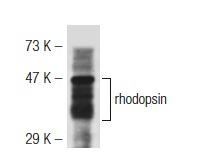
Western blot analysis of rhodopsin expression in mouse eye tissue extract.| Product Name | rhodopsin Antibody (H-100) |
|---|---|
| Antibody Type | Primary Antibodies |
| Modification Notes | G protein-coupled receptors (GPCRs), which are characterized as containing seven transmembrane å helices, elicit G protein-mediated signaling cascades in response to a variety of stimuli. The opsin subfamily, which represents approximately 90 percent of all GPCRs, is comprised of photoreceptors that are activated by light, which include the red-, green- and blue-sensitive opsins and rhodopsin. The opsin subfamily consists of an apoprotein covalently linked to 11-cis-retinal, which undergoes isomerization upon the absorption of photons. This isomerization leads to a conformational change of the protein which results in the activation of hundreds of G proteins. Specifically, rhodopsin exhibits a maximal absorption at 495 nm and mediates vision in dim light. Mutations in the rhodopsin gene lead to retinitis pigmentosa, which can be inherited as an autosomal dominant, an autosomal recessive or an X-linked recessive disorder. |
| Clonality | Polyclonal |
|---|---|
| Isotype | IgG |
| Host Species | Rabbit |
| Tested Applications | WBIPIFELISA |
| recommended for detection of rhodopsin of mouse, rat and human origin by WB, IP, IF and ELISA also reactive with additional species, including equine, canine, bovine and porcine | |
| Species Reactivity | HumanMouseRat |
| Concentration | 1mg/ml |
| Purification | Affinity purified |
| Alternative Names | epitope corresponding to amino acids 1-100 mapping at the N-terminus of rhodopsin of human origin |
|---|---|
| Tissue Specificity | epitope corresponding to amino acids 1-100 mapping at the N-terminus of rhodopsin of human origin |
| Entrez Gene | 6010 |
|---|
Application
Western blot analysis of rhodopsin expression in mouse eye tissue extract.| Application Notes | recommended for detection of rhodopsin of mouse, rat and human origin by WB, IP, IF and ELISA also reactive with additional species, including equine, canine, bovine and porcine |
|---|
| Form | Liquid |
|---|---|
| Storage Instructions | For short-term storage, store at 4° C. For long-term storage, aliquot and store at -20ºC or below. Avoid multiple freeze-thaw cycles. |
| Storage Buffer | phosphate buffered saline , pH 7.4, 150mM NaCl, 0.02% sodium azide and 50% glycerol. |


