Application
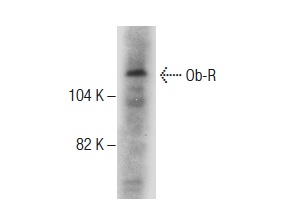
Western blot analysis of Ob-R expression in SH-SY5Y whole cell lysate.Application
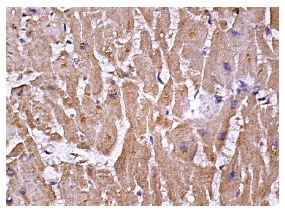
Immunoperoxidase staining of formalin fixed, paraffin-embedded human heart muscle tissue showing cytoplasmic staining of myocytes.| Product Name | Ob-R Antibody (H-300) |
|---|---|
| Antibody Type | Primary Antibodies |
| Modification Notes | Although there is substantial evidence that body weight is physiologically regulated, the molecular basis of obesity is unknown. Five single-gene mutations in mice that result in an obese phenotype have been identified. The first such recessive obesity mutation, the obese mutation (Ob), was identified in 1950. Mutation of Ob results in profound obesity and type II diabetes as part of a syndrome that resembles morbid obesity in humans. It has been postulated that the Ob gene product may function as a component of a signaling pathway in adipose tissue that functions to regulate body fat depot size. The cloning and sequence analysis of the mouse Ob gene and its human homolog has recently been described. Ob encodes an adipose tissue-specific mRNA with a highly conserved 167 amino acid open reading frame. The predicted amino acid sequence is 84% identical between human and mouse and has the features of a secreted protein. A nonsense mutation in codon 105 has been found in the original congenic C57BL/6J Ob/Ob mouse strain. The Ob gene encodes the protein leptin. The leptin receptor, designated Ob-R, has been shown to be a single membrane-spanning receptor that most resembles the gp130 signal transducing component of the IL-6, G-CSF and LIF receptor. Ob-R mRNA is expressed in the choroid plexus and hypothalamus. |
| Clonality | Polyclonal |
|---|---|
| Isotype | IgG |
| Host Species | Rabbit |
| Tested Applications | WBIPIFIHCELISA |
| recommended for detection of short and long forms of Ob-R of mouse, rat and human origin by WB, IP, IF, IHC(P) and ELISA also reactive with additional species, including equine, canine, bovine and porcine | |
| Species Reactivity | HumanMouseRat |
| Concentration | 1mg/ml |
| Purification | Affinity purified |
| Alternative Names | epitope corresponding to amino acids 541-840 mapping within an internal domain of Ob-R of human origin |
|---|---|
| Tissue Specificity | epitope corresponding to amino acids 541-840 mapping within an internal domain of Ob-R of human origin |
| Entrez Gene | 3953 |
|---|
Application
Western blot analysis of Ob-R expression in SH-SY5Y whole cell lysate.
Application
Immunoperoxidase staining of formalin fixed, paraffin-embedded human heart muscle tissue showing cytoplasmic staining of myocytes.| Application Notes | recommended for detection of short and long forms of Ob-R of mouse, rat and human origin by WB, IP, IF, IHC(P) and ELISA also reactive with additional species, including equine, canine, bovine and porcine |
|---|
| Form | Liquid |
|---|---|
| Storage Instructions | For short-term storage, store at 4° C. For long-term storage, aliquot and store at -20ºC or below. Avoid multiple freeze-thaw cycles. |
| Storage Buffer | phosphate buffered saline , pH 7.4, 150mM NaCl, 0.02% sodium azide and 50% glycerol. |


