Application
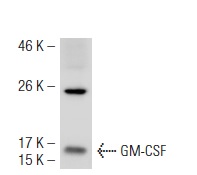
Western blot analysis of GM-CSF expression in human PBL whole cell lysate.Application
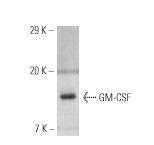
Western blot analysis of human recombinant GM-CSF.| Product Name | GM-CSF Antibody (FL-144) |
|---|---|
| Antibody Type | Primary Antibodies |
| Modification Notes | Colony stimulating factors (CSFs) were initially characterized by their ability to stimulate in vitro colony formation by hematopoietic progenitor cells in semisolid media. Several of these CSFs have been assigned an interleukin number, while three (GM-CSF, G-CSF and M-CSF) have retained their CSF designations. The human granulocyte-macrophage colony stimulating factor (GM-CSF) is a pleiotropic cytokine with a 17 amino acid signal peptide that is cleaved to produce the mature form of 127 amino acids. The mature murine GM-CSF protein is 124 amino acids and shares 60% homology with the human GM-CSF protein. GM-CSF is a glycoprotein that can stimulate the proliferation of hematopoietic cells including granulocytes and macrophages. It has been shown to promote the phosphorylation of cPLA2 in human neutrophils. The phosphorylation of cPLA2 may be accompanied by an increase in enzyme activity. |
| Clonality | Polyclonal |
|---|---|
| Isotype | IgG |
| Host Species | Rabbit |
| Tested Applications | WBIPIFELISA |
| recommended for detection of GM-CSF of r and h origin by WB, IP, IF and ELISA | |
| Species Reactivity | HumanMouseRat |
| Concentration | 1mg/ml |
| Purification | Affinity purified |
| Alternative Names | epitope corresponding to amino acids 1-144 representing full length GM-CSF of human origin |
|---|---|
| Tissue Specificity | epitope corresponding to amino acids 1-144 representing full length GM-CSF of human origin |
| Entrez Gene | 1437 |
|---|
Application
Western blot analysis of GM-CSF expression in human PBL whole cell lysate.
Application
Western blot analysis of human recombinant GM-CSF.| Application Notes | recommended for detection of GM-CSF of r and h origin by WB, IP, IF and ELISA |
|---|
| Form | Liquid |
|---|---|
| Storage Instructions | For short-term storage, store at 4° C. For long-term storage, aliquot and store at -20ºC or below. Avoid multiple freeze-thaw cycles. |
| Storage Buffer | phosphate buffered saline , pH 7.4, 150mM NaCl, 0.02% sodium azide and 50% glycerol. |


