Application
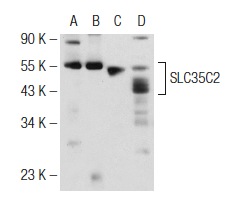
Western blot analysis of SLC35C2 expression in mouse liver (A) and mouse prostate (B) tissue extracts and Hep G2 (C) and MIA PaCa-2 (D) whole cell lysates.| Product Name | SLC35C2 Antibody (S-17) |
|---|---|
| Antibody Type | Primary Antibodies |
| Modification Notes | SLC35C2 (solute carrier family 35, member C2), also known as C20orf5, OVCOV1 or CGI-15, is a 365 amino acid multi-pass membrane protein that belongs to the TPT transporter family and exists as multiple alternatively spliced isoforms. Expressed ubiquitously and functionally induced in hypoxic trophoblast cells, SLC35C2 plays a role in the cellular response to tissue hypoxia and is thought to be involved in the pathogenesis of ovarian cancer. The gene encoding SLC35C2 maps to human chromosome 20, which houses over 600 genes some of which are associated with Creutzfeldt-Jakob disease, amyotrophic lateral sclerosis, spinal muscular atrophy, ring chromosome 20 epilepsy syndrome and Alagille syndrome. Additionally, chromosome 20 contains a region with numerous genes which are thought important for seminal production and may be potential targets for male contraception. |
| Clonality | Polyclonal |
|---|---|
| Isotype | IgG |
| Host Species | Rabbit |
| Tested Applications | WBIPIFELISA |
| recommended for detection of SLC35C2 of mouse, rat and human origin by WB, IP, IF and ELISA also reactive with additional species, including canine | |
| Species Reactivity | HumanMouseRat |
| Concentration | 1mg/ml |
| Purification | Affinity purified |
| Alternative Names | epitope mapping within an internal region of SLC35C2 of human origin |
|---|---|
| Tissue Specificity | epitope mapping within an internal region of SLC35C2 of human origin |
| Entrez Gene | 51006 |
|---|
Application
Western blot analysis of SLC35C2 expression in mouse liver (A) and mouse prostate (B) tissue extracts and Hep G2 (C) and MIA PaCa-2 (D) whole cell lysates.| Application Notes | recommended for detection of SLC35C2 of mouse, rat and human origin by WB, IP, IF and ELISA also reactive with additional species, including canine |
|---|
| Form | Liquid |
|---|---|
| Storage Instructions | For short-term storage, store at 4° C. For long-term storage, aliquot and store at -20ºC or below. Avoid multiple freeze-thaw cycles. |
| Storage Buffer | phosphate buffered saline , pH 7.4, 150mM NaCl, 0.02% sodium azide and 50% glycerol. |


