Application
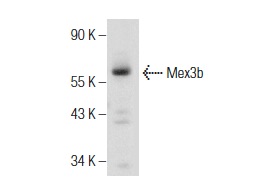
Western blot analysis of Mex3b expression in mouse testis tissue extract.| Product Name | Mex3b Antibody (H-50) |
|---|---|
| Antibody Type | Primary Antibodies |
| Modification Notes | Mex-3 (muscle excess protein-3) is a translational regulator in Caenorhabditis elegans that participates in maintaining the germline totipotency and in specification of posterior blastomeres in early embryos. In humans, four evolutionarily conserved Mex-3 homologs exist, namely Mex3a, Mex3b, Mex3c and Mex3d. These proteins comprise a family of RNA binding phosphoproteins which each contain two tandemly repeated KH (nuclear ribonucleoprotein K homology) domains and one C-terminal RING finger motif. In addition, the Mex-3 homolog family of proteins shuttle between the nucleus and the cytoplasm through the CRM1-dependent export pathway and may play a role regulating post-transcriptional events. |
| Clonality | Polyclonal |
|---|---|
| Isotype | IgG |
| Host Species | Rabbit |
| Tested Applications | WBIPIFELISA |
| recommended for detection of Mex3b of mouse, rat and human origin by WB, IP, IF and ELISA | |
| Species Reactivity | HumanMouseRat |
| Concentration | 1mg/ml |
| Purification | Affinity purified |
| Alternative Names | epitope corresponding to amino acids 336-385 mapping within an internal region of Mex3b of human origin |
|---|---|
| Tissue Specificity | epitope corresponding to amino acids 336-385 mapping within an internal region of Mex3b of human origin |
| Entrez Gene | 84206 |
|---|
Application
Western blot analysis of Mex3b expression in mouse testis tissue extract.| Application Notes | recommended for detection of Mex3b of mouse, rat and human origin by WB, IP, IF and ELISA |
|---|
| Form | Liquid |
|---|---|
| Storage Instructions | For short-term storage, store at 4° C. For long-term storage, aliquot and store at -20ºC or below. Avoid multiple freeze-thaw cycles. |
| Storage Buffer | phosphate buffered saline , pH 7.4, 150mM NaCl, 0.02% sodium azide and 50% glycerol. |


