Application
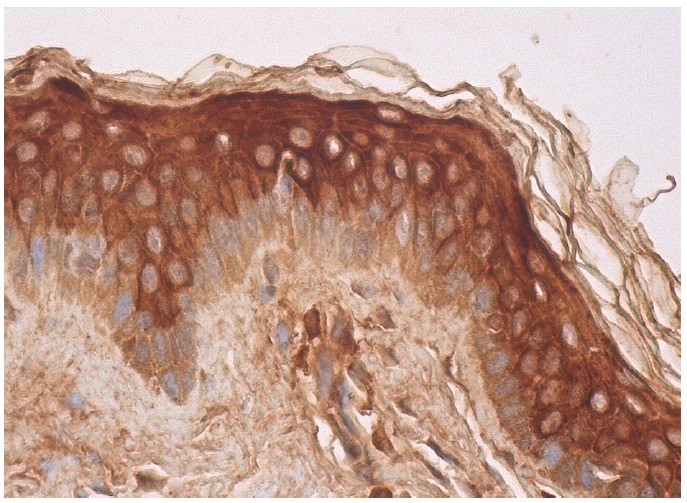
Immunoperoxidase staining of formalin fixed, paraffin-embedded human skin tissue showing cytoplasmic staining of fibroblasts, keratinocytes, melanocytes and Langerhans cells.| Product Name | PiT1 Antibody (H-130) |
|---|---|
| Antibody Type | Primary Antibodies |
| Modification Notes | The SLC20 family transport proteins were originally identified as retroviral receptors Glvr-1 and Ram-1, but are now designated sodium-dependent phosphate transporters 1 and 2 (PiT1 and PiT2). The PiT proteins function as sodium-phosphate cotransporters and are widely expressed, with high expression in bone, kidney and intestine. Both PiT1 and PiT2 are expressed on polarized epithelial cell membranes where they play a role in cellular phosphate homeo-stasis. PiT2 is a human receptor for amphotropic murine leukemia virus (A-MuLV). A-MuLV infects a variety of mammalian cell lines, including humans, making it a useful tool in gene transfer technology and as a vector for gene therapy. Retroviral vector systems are used in gene therapy that are designed to infect cells expressing PiT1 or PiT2. |
| Clonality | Polyclonal |
|---|---|
| Isotype | IgG |
| Host Species | Rabbit |
| Tested Applications | WBIPIFELISA |
| recommended for detection of PiT1 of mouse, rat and human origin by WB, IP, IF and ELISA also reactive with additional species, including canine, bovine and porcine | |
| Species Reactivity | HumanMouseRat |
| Concentration | 1mg/ml |
| Purification | Affinity purified |
| Alternative Names | epitope corresponding to amino acids 251-380 mapping within an internal region of PiT1 of human origin |
|---|---|
| Tissue Specificity | epitope corresponding to amino acids 251-380 mapping within an internal region of PiT1 of human origin |
| Entrez Gene | 6574 |
|---|
Application
Immunoperoxidase staining of formalin fixed, paraffin-embedded human skin tissue showing cytoplasmic staining of fibroblasts, keratinocytes, melanocytes and Langerhans cells.| Application Notes | recommended for detection of PiT1 of mouse, rat and human origin by WB, IP, IF and ELISA also reactive with additional species, including canine, bovine and porcine |
|---|
| Form | Liquid |
|---|---|
| Storage Instructions | For short-term storage, store at 4° C. For long-term storage, aliquot and store at -20ºC or below. Avoid multiple freeze-thaw cycles. |
| Storage Buffer | phosphate buffered saline , pH 7.4, 150mM NaCl, 0.02% sodium azide and 50% glycerol. |


