Application
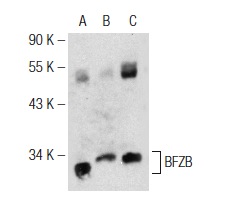
Western blot analysis of BFZB expression in Hep G2 (A), SKBR-3 (B) and MCF7 (C) whole cell lysates.| Product Name | BFZB Antibody (I-16) |
|---|---|
| Antibody Type | Primary Antibodies |
| Modification Notes | BFZB (Basic FGF-repressed Zic-binding protein), also known as UQCC (Ubiquinol-cytochrome c reductase complex chaperone CBP3 homolog), is a 299 amino acid protein that localizes to vesicles of the cytoplasm. With expression in the developing nervous system, ganglia of cranial nerves V, VII, VIII, IX and X, dorsal root ganglia, developing eye, brown fat and differentiating chondrocytes, BFZB may play a role in height determination and early development. A single nucleotide polymorphism (SNP) in the gene encoding BFZB is highly correlated with a functional SNP in the neighboring GDF-5 gene, which is associated with an increased risk of osetoarthritis. The SNP in the gene encoding BFZB is also associated with increased height, explaining 0.3-0.5% of the variance in height in both males and females. There are four isoforms of BFZB which are produced as a result of alternative splicing events. |
| Clonality | Polyclonal |
|---|---|
| Isotype | IgG |
| Host Species | Rabbit |
| Tested Applications | WBIPIFELISA |
| recommended for detection of BFZB of mouse, rat and human origin by WB, IP, IF and ELISA non cross-reactive with isoform 3 also reactive with additional species, including equine, canine, bovine, porcine and avian | |
| Species Reactivity | HumanMouseRat |
| Concentration | 1mg/ml |
| Purification | Affinity purified |
| Alternative Names | epitope mapping within an internal region of BFZB of human origin |
|---|---|
| Tissue Specificity | epitope mapping within an internal region of BFZB of human origin |
| Entrez Gene | 55245 |
|---|
Application
Western blot analysis of BFZB expression in Hep G2 (A), SKBR-3 (B) and MCF7 (C) whole cell lysates.| Application Notes | recommended for detection of BFZB of mouse, rat and human origin by WB, IP, IF and ELISA non cross-reactive with isoform 3 also reactive with additional species, including equine, canine, bovine, porcine and avian |
|---|
| Form | Liquid |
|---|---|
| Storage Instructions | For short-term storage, store at 4° C. For long-term storage, aliquot and store at -20ºC or below. Avoid multiple freeze-thaw cycles. |
| Storage Buffer | phosphate buffered saline , pH 7.4, 150mM NaCl, 0.02% sodium azide and 50% glycerol. |


