Application
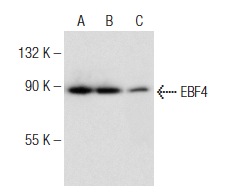
Western blot analysis of EBF4 expression in U-698-M (A), Daudi (B) and Jurkat (C) whole cell lysates.Application
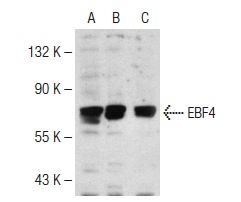
Western blot analysis of EBF4 expression in Daudi (A), JM1 (B) and U-698-M (C) whole cell lysates.| Product Name | EBF4 Antibody (A-12) |
|---|---|
| Antibody Type | Primary Antibodies |
| Modification Notes | B lymphocyte maturation is an intricate process that requires a distinct set of transcription factors with respect to the stage of cell differentiation and cell lineage. Among the transcriptional regulators involved in the early stages of B cell development, EBF4 (early B-cell factor 4), also known as transcription factor COE4, is a 602 amino acid nuclear protein that binds the Olf1 site, the consensus sequence 5'-ATTCCCNNGGGAATT-3'. Like other members of the Olf-1/EBF (O/E) family of transcription factors, EBF4 may play an important role in B-cell maturation and neural development. There are two isoforms of EBF4 that exist as a result of alternative splicing events. In regards to transcriptional activation of a reporter construct, all EBF4 isoforms are weaker than EBF, EBF2 and EBF3. By interacting with other O/E family members, EBF4 most likely forms homodimers or heterodimers to regulate gene expression. |
| Clonality | Polyclonal |
|---|---|
| Isotype | IgG |
| Host Species | Rabbit |
| Tested Applications | WBIPIFELISA |
| recommended for detection of EBF4 of mouse, rat and human origin by WB, IP, IF and ELISA non cross-reactive with family member EBF also reactive with additional species, including canine | |
| Species Reactivity | HumanMouseRat |
| Concentration | 1mg/ml |
| Purification | Affinity purified |
| Alternative Names | epitope mapping within an internal region of EBF4 of human origin |
|---|---|
| Tissue Specificity | epitope mapping within an internal region of EBF4 of human origin |
| Entrez Gene | 57593 |
|---|
Application
Western blot analysis of EBF4 expression in U-698-M (A), Daudi (B) and Jurkat (C) whole cell lysates.
Application
Western blot analysis of EBF4 expression in Daudi (A), JM1 (B) and U-698-M (C) whole cell lysates.| Application Notes | recommended for detection of EBF4 of mouse, rat and human origin by WB, IP, IF and ELISA non cross-reactive with family member EBF also reactive with additional species, including canine |
|---|
| Form | Liquid |
|---|---|
| Storage Instructions | For short-term storage, store at 4° C. For long-term storage, aliquot and store at -20ºC or below. Avoid multiple freeze-thaw cycles. |
| Storage Buffer | phosphate buffered saline , pH 7.4, 150mM NaCl, 0.02% sodium azide and 50% glycerol. |


