Application
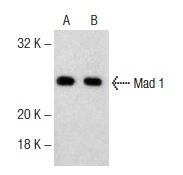
Western blot analysis of Mad 1 expression in HeLa (A) and MCF7 (B) whole cell lysates.Application
Western blot analysis of Mad 1 expression in A-431 (A), C32 (B) and HT-1080 (C) whole cell lysates.| Product Name | Mad 1 Antibody (FL-221) |
|---|---|
| Antibody Type | Primary Antibodies |
| Modification Notes | It is now well established that the nature and relative abundance of individual subunits of different classes of transcription factors can positively or negatively regulate levels of gene expression (1). Myc proteins homodimerize and bind DNA poorly, if at all, at physiological levels (2). Max is a nuclear localized bHLH-Zip protein initially identified by screening a B cell expression library with the bHLH-Zip region of c-Myc (3-6). Max homodimers and the Myc-Max heterodimers bind the sequence CACGTG; however the binding of the heterodimeric complex is stronger than the Max homodimer (3-6). The Max gene products have been identified as (Max) and (Max 9) proteins that differ by a 9 amino acid insertion N-terminal to the basic region (3-6). In contrast to Myc, which is highly regulated during progression through the cell cycle, Max is highly stable and is much more abundant than Myc (5). Two members of the bHLH-Zip protein family, designated Mad (7) and Mxi 1 (8) homodimerize poorly but form heterodimeric complexes with Max that have opposing functions to Myc-Max heterodimers with respect to regulation of gene expression. |
| Clonality | Polyclonal |
|---|---|
| Isotype | IgG |
| Host Species | Rabbit |
| Tested Applications | WBIPIFELISAGSChIP |
| recommended for detection of Mad 1 of mouse, rat and human origin by WB, IP, IF and ELISA also reactive with additional species, including equine, bovine and porcine | |
| Species Reactivity | HumanMouseRat |
| Concentration | 1mg/ml |
| Purification | Affinity purified |
| Alternative Names | epitope corresponding to amino acids 1-221 representing full length Mad 1 protein of human origin |
|---|---|
| Tissue Specificity | epitope corresponding to amino acids 1-221 representing full length Mad 1 protein of human origin |
| Entrez Gene | 4084 |
|---|
Application
Western blot analysis of Mad 1 expression in HeLa (A) and MCF7 (B) whole cell lysates.
Application
Western blot analysis of Mad 1 expression in A-431 (A), C32 (B) and HT-1080 (C) whole cell lysates.| Application Notes | recommended for detection of Mad 1 of mouse, rat and human origin by WB, IP, IF and ELISA also reactive with additional species, including equine, bovine and porcine |
|---|
| Form | Liquid |
|---|---|
| Storage Instructions | For short-term storage, store at 4° C. For long-term storage, aliquot and store at -20ºC or below. Avoid multiple freeze-thaw cycles. |
| Storage Buffer | phosphate buffered saline , pH 7.4, 150mM NaCl, 0.02% sodium azide and 50% glycerol. |


