Application
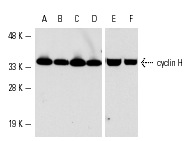
Antibodies tested include cyclin H (C-18): (A-D) and cyclin H (FL-323): (E,F).| Product Name | cyclin H Antibody (FL-323) |
|---|---|
| Antibody Type | Primary Antibodies |
| Modification Notes | Progression through the cell cycle requires activation of a series of enzymes designated cyclin dependent kinases (Cdks). The monomeric catalytic subunit, Cdk2, a critical enzyme for initiation of cell cycle progression, is completely inactive. Partial activation is achieved by the binding of regulatory cyclins such as cyclin D1, while full activation additionally requires phosphorylation at Thr-160. The enzyme responsible for phosphorylation of Thr-160 of Cdk2 and also Thr-161 in Cdc2 p34, designated Cdk-activating kinase (CAK), has been partially purified and shown to be comprised of a catalytic subunit and a regulatory subunit. The catalytic subunit, designated Cdk7, has been identified as the mammalian homolog of MO15, a protein kinase demonstrated earlier in starfish and Xenopus. The regulatory subunit is a novel cyclin (cyclin H) and is required for activation of Cdk7. Like other Cdks, Cdk7 contains a conserved threonine required for full activity; mutation of this residue severely reduces CAK activity. |
| Clonality | Polyclonal |
|---|---|
| Isotype | IgG |
| Host Species | Rabbit |
| Tested Applications | WBIPIFELISA |
| recommended for detection of cyclin H p37 (CAK regulatory subunit) of mouse, rat and human origin by WB, IP, IF and ELISA non cross-reactive with catalytic subunit (Cdk7) also reactive with additional species, including equine, canine and porcine | |
| Species Reactivity | HumanMouseRat |
| Concentration | 1mg/ml |
| Purification | Affinity purified |
| Alternative Names | epitope corresponding to amino acids 1-323 representing full length cyclin H of human origin |
|---|---|
| Tissue Specificity | epitope corresponding to amino acids 1-323 representing full length cyclin H of human origin |
| Entrez Gene | 902 |
|---|
Application
Antibodies tested include cyclin H (C-18): (A-D) and cyclin H (FL-323): (E,F).| Application Notes | recommended for detection of cyclin H p37 (CAK regulatory subunit) of mouse, rat and human origin by WB, IP, IF and ELISA non cross-reactive with catalytic subunit (Cdk7) also reactive with additional species, including equine, canine and porcine |
|---|
| Form | Liquid |
|---|---|
| Storage Instructions | For short-term storage, store at 4° C. For long-term storage, aliquot and store at -20ºC or below. Avoid multiple freeze-thaw cycles. |
| Storage Buffer | phosphate buffered saline , pH 7.4, 150mM NaCl, 0.02% sodium azide and 50% glycerol. |


