Application
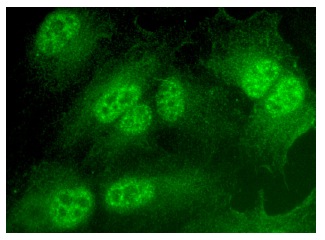
Immunofluorescence staining of formalin-fixed Hep G2 cells showing nuclear and cytoplasmic localization.| Product Name | Grim19 Antibody (H-71) |
|---|---|
| Antibody Type | Primary Antibodies |
| Modification Notes | The GRIM family of proteins appear to be novel types of tumor suppressors. Grim19, which stands for gene associated with retinoic-interferon-induced mortality 19 protein, is also designated cell death-regulatory protein Grim-19 or NADH dehydrogenase ubiquinone 1 alpha subcomplex subunit 13. The Grim19 protein plays two roles within the cell. As a member of the interferon-beta and retinoic acid-induced pathway of cell death, Grim19 induces apoptosis. As part of the mitochondrial complex I, Grim19 is essential for its assembly and electron transfer activity. It transfers electrons to the respiratory chain from NADH and plays a role in the interferon/all-trans-retinoic acid (IFN/RA) cell death pathway. It localizes primarily to the mitochondrion, but may translocate to the nucleus upon IFN/RA treatment. Grim19 may also be useful as a biological marker or target for drug development. |
| Clonality | Polyclonal |
|---|---|
| Isotype | IgG |
| Host Species | Rabbit |
| Tested Applications | WBIPIFELISA |
| recommended for detection of Grim19 of mouse, rat and human origin by WB, IP, IF and ELISA also reactive with additional species, including equine, canine and porcine | |
| Species Reactivity | HumanMouseRat |
| Concentration | 1mg/ml |
| Purification | Affinity purified |
| Alternative Names | epitope corresponding to amino acids 145-215 mapping near the C-terminus of Grim19 of human origin |
|---|---|
| Tissue Specificity | epitope corresponding to amino acids 145-215 mapping near the C-terminus of Grim19 of human origin |
Application
Immunofluorescence staining of formalin-fixed Hep G2 cells showing nuclear and cytoplasmic localization.| Application Notes | recommended for detection of Grim19 of mouse, rat and human origin by WB, IP, IF and ELISA also reactive with additional species, including equine, canine and porcine |
|---|
| Form | Liquid |
|---|---|
| Storage Instructions | For short-term storage, store at 4° C. For long-term storage, aliquot and store at -20ºC or below. Avoid multiple freeze-thaw cycles. |
| Storage Buffer | phosphate buffered saline , pH 7.4, 150mM NaCl, 0.02% sodium azide and 50% glycerol. |


