Application
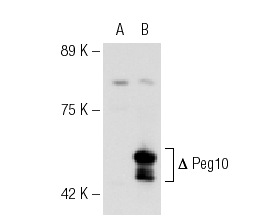
Western blot analysis of Peg10 expression in non-transfected: (A) and truncated human Peg10 transfected: (B) 293T whole cell lysates.| Product Name | Peg10 Antibody (H-160) |
|---|---|
| Antibody Type | Primary Antibodies |
| Modification Notes | Peg10 (Paternally expressed gene 10), also known as EDR, KIAA1051, MAR2, MART2, MEF3L1 or RGAG3, is a 708 amino acid protein that localizes to both the nucleus and they cytoplasm and contains one CCHC-type zinc finger. Expressed in placenta, brain, kidney, liver, thymus, lung, ovary and spleen, Peg10 plays a role in cell growth promotion and apoptosis prevention and is, therefore, thought to be a potent factor in tumor formation and metastasis. Peg10 exists as two distinct isoforms, designated RF1 and RF1/RF2, which have distinctive active sites, but are both associated with cell growth and differentiation control. The gene encoding Peg10 maps to human chromosome 7, which houses over 1,000 genes and comprises nearly 5% of the human genome. Defects in some of the genes localized to chromosome 7 have been linked to Osteogenesis imperfecta, Williams-Beuren syndrome, Pendred syndrome, Lissencephaly, Citrullinemia and Shwachman-Diamond syndrome. |
| Clonality | Polyclonal |
|---|---|
| Isotype | IgG |
| Host Species | Rabbit |
| Tested Applications | WBIPIFELISA |
| recommended for detection of Peg10 of human origin by WB, IP, IF and ELISA may cross-react with myelin expression factor-3-like protein(mouse) | |
| Species Reactivity | HumanMouseRat |
| Concentration | 1mg/ml |
| Purification | Affinity purified |
| Alternative Names | epitope corresponding to amino acids 81-240 mapping near the N-terminus of Peg10 of human origin |
|---|---|
| Tissue Specificity | epitope corresponding to amino acids 81-240 mapping near the N-terminus of Peg10 of human origin |
| Entrez Gene | 23089 |
|---|
Application
Western blot analysis of Peg10 expression in non-transfected: (A) and truncated human Peg10 transfected: (B) 293T whole cell lysates.| Application Notes | recommended for detection of Peg10 of human origin by WB, IP, IF and ELISA may cross-react with myelin expression factor-3-like protein(mouse) |
|---|
| Form | Liquid |
|---|---|
| Storage Instructions | For short-term storage, store at 4° C. For long-term storage, aliquot and store at -20ºC or below. Avoid multiple freeze-thaw cycles. |
| Storage Buffer | phosphate buffered saline , pH 7.4, 150mM NaCl, 0.02% sodium azide and 50% glycerol. |


