Application
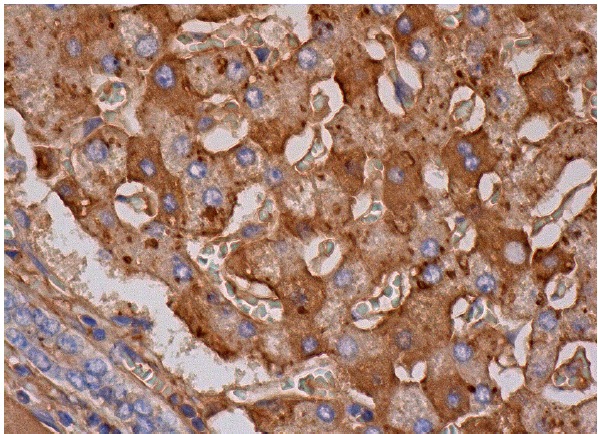
Immunoperoxidase staining of formalin fixed, paraffin-embedded human liver tissue showing basal membrane staining of hepatocytes and cytoplasmic staining of Bile duct cells.| Product Name | MAVS Antibody (H-135) |
|---|---|
| Antibody Type | Primary Antibodies |
| Modification Notes | MAVS (mitochondrial antiviral-signaling protein), also known as IPS1, KIAA1271, VISA or CARDIF, is a 540 amino acid protein that contains one CARD domain and several transmembrane domains, and localizes to the outer mitochondrial membrane. Expressed throughout the body with highest ex-pression in liver, heart, placenta, skeletal muscle and peripheral blood leuk-ocytes, MAVS functions downstream of proteins, such as RIG-I, that detect double-stranded (ds) viral replication and is required for proper immune re-sponse against ds viral infection. MAVS is thought to activate pathways that lead to the induction of antiviral cytokines and may protect the cells from viral-induced apoptosis. MAVS function can be inactivated via cleavage by a protease complex that degrades the CARD and transmembrane domains, thereby preventing MAVS from interacting with other proteins. Three isoforms of MAVS are expressed due to alternative splicing events. |
| Clonality | Polyclonal |
|---|---|
| Isotype | IgG |
| Host Species | Rabbit |
| Tested Applications | WBIPIFELISA |
| recommended for detection of Mitochondrial antiviral-signaling protein of human origin by WB, IP, IF and ELISA | |
| Species Reactivity | HumanMouseRat |
| Concentration | 1mg/ml |
| Purification | Affinity purified |
| Alternative Names | epitope corresponding to amino acids 1-135 mapping within an N-terminal cytoplasmic domain of MAVS of human origin |
|---|---|
| Tissue Specificity | epitope corresponding to amino acids 1-135 mapping within an N-terminal cytoplasmic domain of MAVS of human origin |
| Entrez Gene | 57506 |
|---|
Application
Immunoperoxidase staining of formalin fixed, paraffin-embedded human liver tissue showing basal membrane staining of hepatocytes and cytoplasmic staining of Bile duct cells.| Application Notes | recommended for detection of Mitochondrial antiviral-signaling protein of human origin by WB, IP, IF and ELISA |
|---|
| Form | Liquid |
|---|---|
| Storage Instructions | For short-term storage, store at 4° C. For long-term storage, aliquot and store at -20ºC or below. Avoid multiple freeze-thaw cycles. |
| Storage Buffer | phosphate buffered saline , pH 7.4, 150mM NaCl, 0.02% sodium azide and 50% glycerol. |


