Application
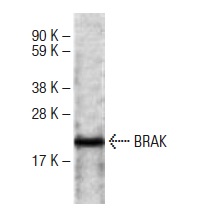
Western blot analysis of BRAK expression in human fetal skeletal muscle tissue extract.| Product Name | BRAK Antibody (P-21) |
|---|---|
| Antibody Type | Primary Antibodies |
| Modification Notes | Breast and kidney-expressed chemokine (BRAK) is a highly selective monocyte chemoattractant. The CXC chemokine BRAK, which is ubiquitously expressed in normal tissue extracts, is absent from many tumor cell lines in vitro. BRAK, also known as CXCL14, is involved in the generation of tissue macrophages by recruiting extravasated precursors to fibroblasts, which are known to secrete essential cytokines for macrophage development. The gene encoding BRAK is located on human chromosome 5q31.This gene belongs to the cytokine family which encodes secreted proteins involved in immunoregulatory and inflammatory processes. The BRAK protein is structurally related to the CXC (Cys-X-Cys) subfamily of cytokines characterized by two cysteines separated by a single amino acid. |
| Clonality | Polyclonal |
|---|---|
| Isotype | IgG |
| Host Species | Rabbit |
| Tested Applications | WBIPELISA |
| Species Reactivity | HumanMouseRat |
| Concentration | 1mg/ml |
| Purification | Affinity purified |
| Alternative Names | recommended for detection of BRAK of mouse rat and human origin by WB IP and ELISA also reactive with additional species including canine |
|---|---|
| Tissue Specificity | recommended for detection of BRAK of mouse, rat and human origin by WB, IP and ELISA; also reactive with additional species, including canine |
| Entrez Gene | 9547 |
|---|
Application
Western blot analysis of BRAK expression in human fetal skeletal muscle tissue extract.| Form | Liquid |
|---|---|
| Storage Instructions | For short-term storage, store at 4° C. For long-term storage, aliquot and store at -20ºC or below. Avoid multiple freeze-thaw cycles. |
| Storage Buffer | phosphate buffered saline , pH 7.4, 150mM NaCl, 0.02% sodium azide and 50% glycerol. |


