Application
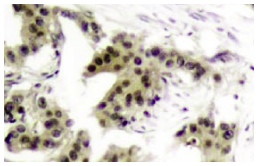
Immunoperoxidase staining of formalin-fixed, paraffin-embedded human breast carcinoma tissue showing cytoplasmmic and nuclear staining.| Product Name | p-NFκB p50 Antibody (Ser 893) |
|---|---|
| Antibody Type | Primary Antibodies |
| Modification Notes | Proteins encoded by the v-Rel viral oncogene and its cellular homolog, c-Rel, are members of a family of transcription factors that include the two subunits of the transcription factor NF˚B (p50 and p65) and the Drosophila maternal morphagen, dorsal. These proteins share sequence homology over a region of 300 amino acids at their NH2-terminus, the region that contains their DNA binding and dimerization domains. The DNA binding activity of NF˚B is activated and rapidly transported from the cytoplasm to the nucleus in cells exposed to mitogens or growth factors. cDNAs encoding precursors for two distinct proteins have been described. These proteins, designated p105 and p100, are highly related but map on different chromosomes. The p105 (p110) precursor contains p50 at its N-terminus and a C-terminal region that when expressed as a separate molecule, designated PdI, binds to p50 and regulates its activity. The NFkB transcription factor is a protein complex consisting of a DNA binding subunit and an associated protein. The DNA binding subunit, also referred to as Rel A, is functionally related to c-Rel p75 and Rel B p68. The p50 subunit is derived from the N-terminus of a precursor designated p105. A second protein designated p52 (previously referred to as p49) is derived from the p100 precursor and may act as an alternative to p50 in NFkB heterodimers. NF˚B p50 serine 337 is phosphorylated in response to PKA. The phosphorylation of NF˚B p50 serine 337 regulates the binding ability of NF˚B p50 and has an impact on NF-kappaB transcription. |
| Clonality | Polyclonal |
|---|---|
| Isotype | IgG |
| Host Species | Rabbit |
| Tested Applications | IFIHC |
| recommended for detection of Ser 893 phosphorylated NF&kappaB p50 of h origin by IF and IHC(P) | |
| Species Reactivity | HumanMouseRat |
| Concentration | 1mg/ml |
| Purification | Affinity purified |
| Alternative Names | epitope corresponding to phosphorylated Ser 893 of NF&kappa B p50 of human origin |
|---|---|
| Tissue Specificity | epitope corresponding to phosphorylated Ser 893 of NFκB p50 of human origin |
| Entrez Gene | 4790 |
|---|
Application
Immunoperoxidase staining of formalin-fixed, paraffin-embedded human breast carcinoma tissue showing cytoplasmmic and nuclear staining.| Application Notes | recommended for detection of Ser 893 phosphorylated NF&kappaB p50 of h origin by IF and IHC(P) |
|---|
| Form | Liquid |
|---|---|
| Storage Instructions | For short-term storage, store at 4° C. For long-term storage, aliquot and store at -20ºC or below. Avoid multiple freeze-thaw cycles. |
| Storage Buffer | phosphate buffered saline , pH 7.4, 150mM NaCl, 0.02% sodium azide and 50% glycerol. |


