Application
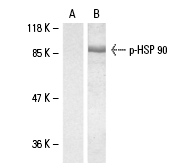
Blots were probed with p-HSP 90 (Ser 254): preincubated with its cognate phosphorylated peptide (A) and p-HSP 90 (Ser 254): (B).| Product Name | p-HSP 90 Antibody (Ser 254) |
|---|---|
| Antibody Type | Primary Antibodies |
| Modification Notes | The heat shock response was first described for Drosophila salivary gland cells and morphologically consists of a change in their polytene chromosome puffing patterns that involves de novo synthesis of a few proteins. Similar heat shock proteins were later discovered in bacterial chicken and mammalian cells, and have been subsequently studied in other organisms. A series of proteins including HSP 90, HSP 70, HSP 20-30 and ubiquitin are induced by insults such as temperature shock, chemicals and other environmental stress. A major function of HSP 90 and other HSPs is to act as molecular chaperones. HSP 90 forms a complex with glucocorticoid receptor (GR), rendering the non ligand-bound receptor transcriptionally inactive. HSP 90 binds the GR as a heterocomplex composed of either HSP 56 or Cyclophilin D, forming an aporeceptor comiplex. HSP 90 also exists as a dimer with other proteins such as p60/sti1 and p23, forming an apo-receptor complex with estrogen and androgen receptors. |
| Clonality | Polyclonal |
|---|---|
| Isotype | IgG |
| Host Species | Rabbit |
| Tested Applications | WBIP |
| recommended for detection of Ser 254 phosphorylated HSP 90 of human and mouse origin and correspondingly phosphorylated Ser 255 of rat origin by WB and IP | |
| Species Reactivity | HumanMouseRat |
| Concentration | 1mg/ml |
| Purification | Affinity purified |
| Alternative Names | epitope corresponding to phosphorylated Ser 254 of HSP 90 of human origin |
|---|---|
| Tissue Specificity | epitope corresponding to phosphorylated Ser 254 of HSP 90 of human origin |
| Entrez Gene | 3326 |
|---|
Application
Blots were probed with p-HSP 90 (Ser 254): preincubated with its cognate phosphorylated peptide (A) and p-HSP 90 (Ser 254): (B).| Application Notes | recommended for detection of Ser 254 phosphorylated HSP 90 of human and mouse origin and correspondingly phosphorylated Ser 255 of rat origin by WB and IP |
|---|
| Form | Liquid |
|---|---|
| Storage Instructions | For short-term storage, store at 4° C. For long-term storage, aliquot and store at -20ºC or below. Avoid multiple freeze-thaw cycles. |
| Storage Buffer | phosphate buffered saline , pH 7.4, 150mM NaCl, 0.02% sodium azide and 50% glycerol. |


