Application
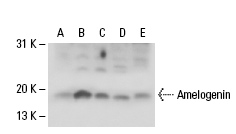
Western blot analysis of Amelogenin expression in NIH/3T3 (A), U-2 OS (B), Saos-2 (C), K-562 (D) and LADMAC (E) whole cell lysates.| Product Name | Amelogenin Antibody (FL-191) |
|---|---|
| Antibody Type | Primary Antibodies |
| Modification Notes | Dental enamel is a highly mineralized tissue with most of its volume occupied by large, highly organized, hydroxyapatite crystals. This structure is thought to be controlled through the interaction of many organic matrix molecules including Amelogenin, Ameloblastin, Enamelin, Tuftelin and several other enzymes. All of these secreted proteins are involved in the mineralization and enamel matrix formation in developing tooth enamel. The gene AMELX which encodes for the protein Amelogenin, is encoded on the X-chromosome. Amelogenin, also designated AMG, AMGX or AMEX, is involved in biomineralization and organization of developing enamel. It functions by regulating crystallite formation during the secretory stage of enamel development. Amelogenin, which localizes to the extracellular matrix, is expressed by ameloblasts and is the predominant protein in developing dental enamel. Defects in the AMELX gene can cause amelogenesis imperfecta hypoplastic type 1 (AIH1) which is an X-linked disease that affects the formation of tooth enamel. |
| Clonality | Polyclonal |
|---|---|
| Isotype | IgG |
| Host Species | Rabbit |
| Tested Applications | WBIPIFELISA |
| recommended for detection of Amelogenin X and Y isoforms of mouse, rat and human origin by WB, IP, IF and ELISA also reactive with additional species, including canine, bovine and porcine | |
| Species Reactivity | HumanMouseRat |
| Concentration | 1mg/ml |
| Purification | Affinity purified |
| Alternative Names | epitope corresponding to amino acids 1-191 representing full length Amelogenin X isoform of human origin |
|---|---|
| Tissue Specificity | epitope corresponding to amino acids 1-191 representing full length Amelogenin X isoform of human origin |
| Entrez Gene | 265 |
|---|
Application
Western blot analysis of Amelogenin expression in NIH/3T3 (A), U-2 OS (B), Saos-2 (C), K-562 (D) and LADMAC (E) whole cell lysates.| Application Notes | recommended for detection of Amelogenin X and Y isoforms of mouse, rat and human origin by WB, IP, IF and ELISA also reactive with additional species, including canine, bovine and porcine |
|---|
| Form | Liquid |
|---|---|
| Storage Instructions | For short-term storage, store at 4° C. For long-term storage, aliquot and store at -20ºC or below. Avoid multiple freeze-thaw cycles. |
| Storage Buffer | phosphate buffered saline , pH 7.4, 150mM NaCl, 0.02% sodium azide and 50% glycerol. |


