Application
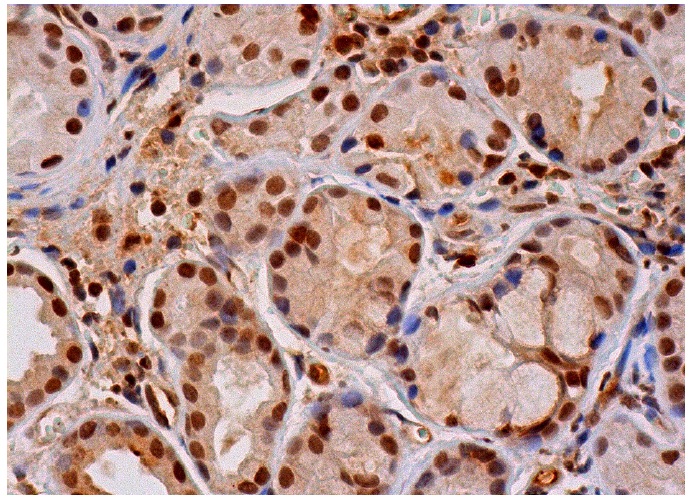
Immunoperoxidase staining of formalin fixed, paraffin-embedded human salivary gland tissue showing nuclear and cytoplasmic staining of glandular cells.| Product Name | BAG-6 Antibody (H-300) |
|---|---|
| Antibody Type | Primary Antibodies |
| Modification Notes | BAT3 (HLA-B associated transcript 3), also known as G3, scythe, BAG6 or D6S52E, is a proline-rich nuclear protein with an important role as an apoptotic regulator. BAT3 contains one ubiquitin-like domain at its N-terminus and two nuclear localization signals at its C-terminus. Specifically, BAT3 interacts with and stabilizes AIF (apoptosis inducing factor), thereby sensitizing the cell to apoptosis mediated by endoplasmic reticulum (ER) stress. Upon ricin treatment, BAT3 is cleaved by caspase-3 and its C-terminal fragment displays pro-apoptotic activities. The apoptotic activities executed include nuclear condensation, phosphatidlyserine externalization, cell rounding and shrinkage. Mice that are deficient in BAT3 exhibit pronounced defects in lung, brain and kidney development and in the regulation of proliferation and apoptosis. These defects ultimately result in perinatal or midgestational lethality. |
| Clonality | Polyclonal |
|---|---|
| Isotype | IgG |
| Host Species | Rabbit |
| Tested Applications | WBIPIFELISA |
| recommended for detection of BAG-6 of mouse, rat and human origin by WB, IP, IF and ELISA also reactive with additional species, including equine, canine, bovine and porcine | |
| Species Reactivity | HumanMouseRat |
| Concentration | 1mg/ml |
| Purification | Affinity purified |
| Alternative Names | epitope corresponding to amino acids 833-982 mapping at the C-terminus of BAG-6 of human origin |
|---|---|
| Tissue Specificity | epitope corresponding to amino acids 833-982 mapping at the C-terminus of BAG-6 of human origin |
| Entrez Gene | 7917 |
|---|
Application
Immunoperoxidase staining of formalin fixed, paraffin-embedded human salivary gland tissue showing nuclear and cytoplasmic staining of glandular cells.| Application Notes | recommended for detection of BAG-6 of mouse, rat and human origin by WB, IP, IF and ELISA also reactive with additional species, including equine, canine, bovine and porcine |
|---|
| Form | Liquid |
|---|---|
| Storage Instructions | For short-term storage, store at 4° C. For long-term storage, aliquot and store at -20ºC or below. Avoid multiple freeze-thaw cycles. |
| Storage Buffer | phosphate buffered saline , pH 7.4, 150mM NaCl, 0.02% sodium azide and 50% glycerol. |


