Application
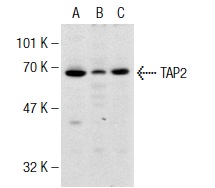
Western blot analysis of TAP2 expression in K-562 (A), CCRF-CEM (B) and MOLT-4 (C) nuclear extracts.Application
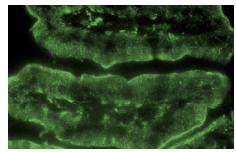
Immunofluorescence staining of normal mouse intestine frozen section showing cytoplasmic staining.| Product Name | TAP2 Antibody (H-210) |
|---|---|
| Antibody Type | Primary Antibodies |
| Modification Notes | The transporter associated with antigen processing (TAP) is a member of the ATP-binding cassette (ABC) family of transmembrane transporters and is an essential component of the major histocompatability complex (MHC) class I antigen-presenting pathway (1). TAP consists of two structurally related subunits, TAP1 and TAP2, that associate into stable dimers and together they form a translocation pore for peptides in the endoplasmic reticulum (ER) membranes (2,3). The functional TAP transporter facilitates the translocation of peptides from the cytosol into the ER lumen for presentation to MHC class I molecules (4). Structurally, TAP1 and TAP2 contain an N-terminal transmembrane (TM) region, which together forms the TM pore, and a cytoplasmic peptide-binding pocket (5,6). In addition, the TAP transporter also contains several C-terminal nucleotide-binding domains (NBD), which bind and hydrolyze ATP and in turn, induce structural changes at the membrane to allow the passage of substrates into the ER (7). |
| Clonality | Polyclonal |
|---|---|
| Isotype | IgG |
| Host Species | Rabbit |
| Tested Applications | WBIPIFELISA |
| recommended for detection of TAP2 of mouse, rat and human origin by WB, IP, IF and ELISA | |
| Species Reactivity | HumanMouseRat |
| Concentration | 1mg/ml |
| Purification | Affinity purified |
| Alternative Names | epitope corresponding to amino acids 21-230 of TAP2 of human origin |
|---|---|
| Tissue Specificity | epitope corresponding to amino acids 21-230 of TAP2 of human origin |
| Entrez Gene | 6891 |
|---|
Application
Western blot analysis of TAP2 expression in K-562 (A), CCRF-CEM (B) and MOLT-4 (C) nuclear extracts.
Application
Immunofluorescence staining of normal mouse intestine frozen section showing cytoplasmic staining.| Application Notes | recommended for detection of TAP2 of mouse, rat and human origin by WB, IP, IF and ELISA |
|---|
| Form | Liquid |
|---|---|
| Storage Instructions | For short-term storage, store at 4° C. For long-term storage, aliquot and store at -20ºC or below. Avoid multiple freeze-thaw cycles. |
| Storage Buffer | phosphate buffered saline , pH 7.4, 150mM NaCl, 0.02% sodium azide and 50% glycerol. |


