Application
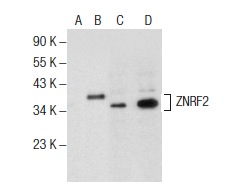
Western blot analysis of ZNRF2 expression in non-transfected 293T: (A), human ZNRF2 transfected 293T: (B), Jurkat (C) and IMR-32 (D) whole cell lysates.| Product Name | ZNRF2 Antibody (T-13) |
|---|---|
| Antibody Type | Primary Antibodies |
| Modification Notes | Ubiquitination is an important mechanism through which three classes of enzymes act in concert to target short-lived or abnormal proteins for destruction. The three classes of enzymes involved in ubiquitination are the ubiquitin-activating enzymes (E1s), the ubiquitin-conjugating enzymes (E2s) and the ubiquitin-protein ligases (E3s). ZNRF2 (zinc and ring finger 2), also known as RNF202, is a 242 amino acid peripheral membrane protein that contains one RING-type zinc finger and localizes to the lysosome, as well as the endosome and the cell junction. Expressed at high levels in brain tissue, ZNRF2 is thought to function as an E3 ubiquitin-protein ligase that may be involved in the establishment and maintenance of neuronal transmission and plasticity. Upon DNA damage, ZNRF2 is subject to phosphorylation, probably by ATR or ATM. |
| Clonality | Polyclonal |
|---|---|
| Isotype | IgG |
| Host Species | Rabbit |
| Tested Applications | WBIPIFELISA |
| recommended for detection of ZNRF2 of mouse and human origin by WB, IP, IF and ELISA non cross-reactive with other ZNRF family members also reactive with additional species, including equine, canine, bovine, porcine and avian | |
| Species Reactivity | HumanMouseRat |
| Concentration | 1mg/ml |
| Purification | Affinity purified |
| Alternative Names | epitope mapping near the C-terminus of ZNRF2 of human origin |
|---|---|
| Tissue Specificity | epitope mapping near the C-terminus of ZNRF2 of human origin |
| Entrez Gene | 223082 |
|---|
Application
Western blot analysis of ZNRF2 expression in non-transfected 293T: (A), human ZNRF2 transfected 293T: (B), Jurkat (C) and IMR-32 (D) whole cell lysates.| Application Notes | recommended for detection of ZNRF2 of mouse and human origin by WB, IP, IF and ELISA non cross-reactive with other ZNRF family members also reactive with additional species, including equine, canine, bovine, porcine and avian |
|---|
| Form | Liquid |
|---|---|
| Storage Instructions | For short-term storage, store at 4° C. For long-term storage, aliquot and store at -20ºC or below. Avoid multiple freeze-thaw cycles. |
| Storage Buffer | phosphate buffered saline , pH 7.4, 150mM NaCl, 0.02% sodium azide and 50% glycerol. |


