Application
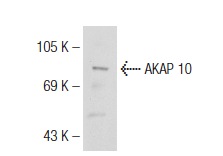
Western blot analysis of AKAP 10 expression in RAW 264.7 whole cell lysate.| Product Name | AKAP 10 Antibody (H-155) |
|---|---|
| Antibody Type | Primary Antibodies |
| Modification Notes | The type II cAMP-protein kinase (PKA) is a multifunctional kinase with a broad range of substrates. Specificity of PKA signaling is thought to be mediated by the compartmentalization of the kinase to specific sites within the cell. To maintain this specific localization, the regulatory (R) subunits (RI and RII) of PKA interact with specific R-anchoring proteins designated AKAPs (A-kinase anchoring proteins). AKAP 10 (A kinase anchor protein 10), also known as PRKA10 or D-AKAP2 (dual-specific A kinase-anchoring protein 2), is a 662 amino acid mitochondrial membrane protein that belongs to the AKAP family. AKAP 10 is a dual specificity protein that binds to both type I and type II regulatory subunits of PKA and anchors them to the plasma membrane or the mitochondria. When anchored to the mitochondria, PKA can phosphorylate and, thus, inactivate the proapoptotic protein Bad. This suggests that AKAP 10 indirectly regulates Bad-induced apoptosis by mediating the mitochondrial attachment of PKA. Additionally, AKAP 10 may facilitate G-protein coupled signal transduction and could act as an adaptor in the assembly of multiprotein complexes. |
| Clonality | Polyclonal |
|---|---|
| Isotype | IgG |
| Host Species | Rabbit |
| Tested Applications | WBIPIFELISA |
| recommended for detection of AKAP 10 of mouse, rat and human origin by WB, IP, IF and ELISA also reactive with additional species, including equine, canine, bovine and porcine | |
| Species Reactivity | HumanMouseRat |
| Concentration | 1mg/ml |
| Purification | Affinity purified |
| Alternative Names | epitope corresponding to amino acids 508-662 mapping at the C-terminus of AKAP 10 of human origin |
|---|---|
| Tissue Specificity | epitope corresponding to amino acids 508-662 mapping at the C-terminus of AKAP 10 of human origin |
| Entrez Gene | 11216 |
|---|
Application
Western blot analysis of AKAP 10 expression in RAW 264.7 whole cell lysate.| Application Notes | recommended for detection of AKAP 10 of mouse, rat and human origin by WB, IP, IF and ELISA also reactive with additional species, including equine, canine, bovine and porcine |
|---|
| Form | Liquid |
|---|---|
| Storage Instructions | For short-term storage, store at 4° C. For long-term storage, aliquot and store at -20ºC or below. Avoid multiple freeze-thaw cycles. |
| Storage Buffer | phosphate buffered saline , pH 7.4, 150mM NaCl, 0.02% sodium azide and 50% glycerol. |


