Application
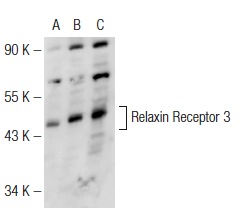
Western blot analysis of Relaxin Receptor 3 expression in non-transfected 293T: (A), human Relaxin Receptor 3 transfected 293T: (B) and HeLa (C) whole cell lysates.| Product Name | Relaxin Receptor 3 Antibody (H-135) |
|---|---|
| Antibody Type | Primary Antibodies |
| Modification Notes | Relaxin Receptor 3 (also known as Relaxin/insulin-like family peptide receptor 3, RXFP3, RLN3R1, GPCR135 and SALPR) is a G protein-coupled receptor that binds Relaxin 3 and influences differentiation and maintenance of the nervous system. Relaxin Receptor 3 shares sequence similarity with somatostatin receptors and angiotensin receptors. It mediates central processing of sensory signals in the rat and is thought to be a modulator of stress responses. Relaxin Receptor 3 is present in the brain, with highest expression in substantia nigra and pituitary, followed by hippocampus, spinal cord, amygdala, caudate nucleus and corpus callosum, and low level expression in cerebellum. In peripheral tissues there are high levels in adrenal glands and low levels in pancreas, salivery gland, placenta, mammary gland and testis. |
| Clonality | Polyclonal |
|---|---|
| Isotype | IgG |
| Host Species | Rabbit |
| Tested Applications | WBIPIFELISA |
| recommended for detection of Relaxin Receptor 3 of mouse, rat and human origin by WB, IP, IF and ELISA also reactive with additional species, including equine, bovine and porcine | |
| Species Reactivity | HumanMouseRat |
| Concentration | 1mg/ml |
| Purification | Affinity purified |
| Alternative Names | epitope corresponding to amino acids 1-135 mapping at the N-terminus of Relaxin Receptor 3 of human origin |
|---|---|
| Tissue Specificity | epitope corresponding to amino acids 1-135 mapping at the N-terminus of Relaxin Receptor 3 of human origin |
| Entrez Gene | 51289 |
|---|
Application
Western blot analysis of Relaxin Receptor 3 expression in non-transfected 293T: (A), human Relaxin Receptor 3 transfected 293T: (B) and HeLa (C) whole cell lysates.| Application Notes | recommended for detection of Relaxin Receptor 3 of mouse, rat and human origin by WB, IP, IF and ELISA also reactive with additional species, including equine, bovine and porcine |
|---|
| Form | Liquid |
|---|---|
| Storage Instructions | For short-term storage, store at 4° C. For long-term storage, aliquot and store at -20ºC or below. Avoid multiple freeze-thaw cycles. |
| Storage Buffer | phosphate buffered saline , pH 7.4, 150mM NaCl, 0.02% sodium azide and 50% glycerol. |


