Application
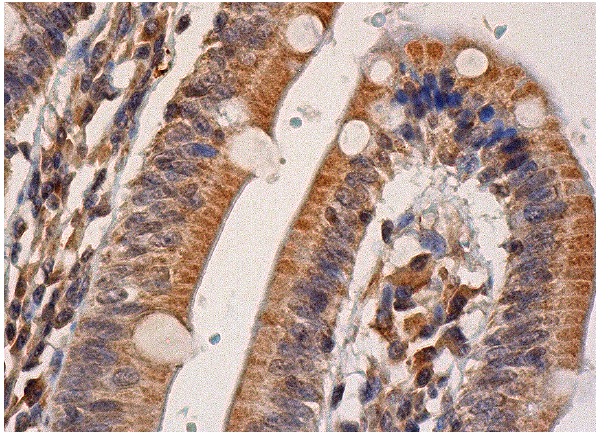
Immunoperoxidase staining of formalin fixed, paraffin-embedded human small intestine tissue showing cytoplasmic staining of glandular cells.| Product Name | MAGI-1 Antibody (H-70) |
|---|---|
| Antibody Type | Primary Antibodies |
| Modification Notes | The membrane-associated guanylate kinase (MAGUK) proteins are concentrated at the membrane-cytoskeletal interface where they facilitate the assembly of multiprotein complexes on the inner surface of the plasma membrane. Three protein-protein interaction modules characteristically define MAGUK related proteins: the PDZ domain, the SH3 domain and the guanylate kinase (GuK) domain. The closely related MAGUK proteins, MAGI-1, MAGI-2 and MAGI-3 (membrane associated guanylate kinase inverted-1 and 2), likewise contain the GuK domain and five PDZ domains; however, the SH3 domain is replaced with a WW domain. The transcripts of MAGI-1 are alternatively spliced to produce three distinct proteins having unique C-terminals. Two variants, MAGI-1a and MAGI-1b, are associated with the membrane and cytosolic fractions and are primarily expressed in the brain. The third isoform, MAGI-1c, encodes for a nuclear localization signal that localizes MAGI-1c to the nucleus, and it is primarily expressed in the liver and kidney. MAGI-2 and MAGI-3 are localized to the plasma membrane, and they contribute to protein scaffolding by associating with the protein phosphatase PTEN. |
| Clonality | Polyclonal |
|---|---|
| Isotype | IgG |
| Host Species | Rabbit |
| Tested Applications | WBIPIFIHCELISA |
| recommended for detection of MAGI-1 of mouse, rat and human origin by WB, IP, IF, IHC(P) and ELISA also reactive with additional species, including equine, bovine and porcine | |
| Species Reactivity | HumanMouseRat |
| Concentration | 1mg/ml |
| Purification | Affinity purified |
| Alternative Names | epitope corresponding to amino acids 1-70 mapping at the N-terminus of MAGI-1 of human origin |
|---|---|
| Tissue Specificity | epitope corresponding to amino acids 1-70 mapping at the N-terminus of MAGI-1 of human origin |
| Entrez Gene | 9223 |
|---|
Application
Immunoperoxidase staining of formalin fixed, paraffin-embedded human small intestine tissue showing cytoplasmic staining of glandular cells.| Application Notes | recommended for detection of MAGI-1 of mouse, rat and human origin by WB, IP, IF, IHC(P) and ELISA also reactive with additional species, including equine, bovine and porcine |
|---|
| Form | Liquid |
|---|---|
| Storage Instructions | For short-term storage, store at 4° C. For long-term storage, aliquot and store at -20ºC or below. Avoid multiple freeze-thaw cycles. |
| Storage Buffer | phosphate buffered saline , pH 7.4, 150mM NaCl, 0.02% sodium azide and 50% glycerol. |


