Application
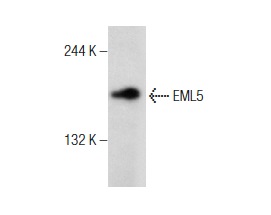
Western blot analysis of EML5 expression in rat brain tissue extract.| Product Name | EML5 Antibody (C-15) |
|---|---|
| Antibody Type | Primary Antibodies |
| Modification Notes | EML5 (echinoderm microtubule-associated protein-like 5), also known as EMAP-5 or EMAP-2, is a 1,169 amino acid cytoplasmic protein that belongs to the WD repeat EMAP family. EML5 is thought to modify the assembly dynamics of microtubules, perhaps causing slightly longer and more dynamic microtubules. EML5 contains 29 WD repeats, a motif known to mediate protein-protein interactions, and is expressed as five isoforms produced by alternative splicing. The gene that encodes EML5 maps to human chromosome 14, which houses over 700 genes and comprises nearly 3.5% of the human genome. Chromosome 14 encodes the presinilin 1 (PSEN1) gene, which is one of the three key genes associated with the development of Alzheimer's disease (AD). The SERPINA1 gene is also located on chromosome 14 and, when defective, leads to the genetic disorder å1-antitrypsin deficiency, which is characterized by severe lung complications and liver dysfunction. |
| Clonality | Polyclonal |
|---|---|
| Isotype | IgG |
| Host Species | Rabbit |
| Tested Applications | WBIPIFELISA |
| recommended for detection of EML5 of mouse, rat and human origin by WB, IP, IF and ELISA non cross-reactive with other EML family members also reactive with additional species, including equine, canine, bovine, porcine and avian | |
| Species Reactivity | HumanMouseRat |
| Concentration | 1mg/ml |
| Purification | Affinity purified |
| Alternative Names | epitope mapping at the C-terminus of EML5 of human origin |
|---|---|
| Tissue Specificity | epitope mapping at the C-terminus of EML5 of human origin |
| Entrez Gene | 161436 |
|---|
Application
Western blot analysis of EML5 expression in rat brain tissue extract.| Application Notes | recommended for detection of EML5 of mouse, rat and human origin by WB, IP, IF and ELISA non cross-reactive with other EML family members also reactive with additional species, including equine, canine, bovine, porcine and avian |
|---|
| Form | Liquid |
|---|---|
| Storage Instructions | For short-term storage, store at 4° C. For long-term storage, aliquot and store at -20ºC or below. Avoid multiple freeze-thaw cycles. |
| Storage Buffer | phosphate buffered saline , pH 7.4, 150mM NaCl, 0.02% sodium azide and 50% glycerol. |


