Application
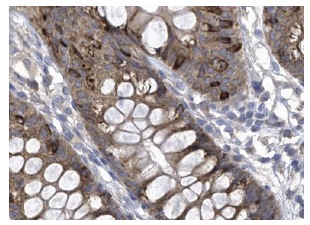
Immunoperoxidase staining of formalin fixed, paraffin-embedded human colon tissue showing cytoplasmic staining of glandular cells.Application
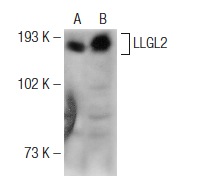
Western blot analysis of LLGL2 expression in ES-2 (A) and K-562 (B) whole cell lysates.| Product Name | LLGL2 Antibody (H-58) |
|---|---|
| Antibody Type | Primary Antibodies |
| Modification Notes | LLGL2 (lethal giant larvae homolog 2), also referred to as HGL or LGL2, is a cortical cytoskeleton protein that is a part of a larger complex of proteins. The complex, which consists of LGN, PKC i and PAR-6∫, may play a role in ensuring thecorrect organization and orientation of bipolar spindles for normal cell division and for the initial phase of the establishment of epithelial cell polarity. in Drosophila melanogaster, LLGL2 is required in follicle cells for the differentiation of both stalk cells and posterior follicle cells. In humans, LLGL2 may be involved in cell proliferation control and tumorigenesis. Phosphorylation of LLGL2 is induced during cell polarization and may contribute to the segregation of LLGL2 from the PKC i and PAR-6∫ complex. Overexpression of LLGL2 is thought to inhibit tight junction formation in cells. LLGL2 is expressed in the cytoplasm and localizes to the perinuclear structure of the cell. |
| Clonality | Polyclonal |
|---|---|
| Isotype | IgG |
| Host Species | Rabbit |
| Tested Applications | WBIPIFELISA |
| recommended for detection of LLGL2 of mouse, rat and human origin by WB, IP, IF and ELISA also reactive with additional species, including canine, bovine and porcine | |
| Species Reactivity | HumanMouseRat |
| Concentration | 1mg/ml |
| Purification | Affinity purified |
| Alternative Names | epitope corresponding to amino acids 148-205 mapping within an internal region of LLGL2 of human origin |
|---|---|
| Tissue Specificity | epitope corresponding to amino acids 148-205 mapping within an internal region of LLGL2 of human origin |
| Entrez Gene | 3993 |
|---|
Application
Immunoperoxidase staining of formalin fixed, paraffin-embedded human colon tissue showing cytoplasmic staining of glandular cells.
Application
Western blot analysis of LLGL2 expression in ES-2 (A) and K-562 (B) whole cell lysates.| Application Notes | recommended for detection of LLGL2 of mouse, rat and human origin by WB, IP, IF and ELISA also reactive with additional species, including canine, bovine and porcine |
|---|
| Form | Liquid |
|---|---|
| Storage Instructions | For short-term storage, store at 4° C. For long-term storage, aliquot and store at -20ºC or below. Avoid multiple freeze-thaw cycles. |
| Storage Buffer | phosphate buffered saline , pH 7.4, 150mM NaCl, 0.02% sodium azide and 50% glycerol. |


