Application
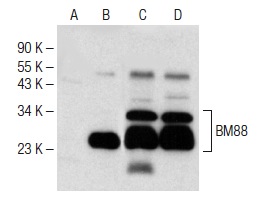
Western blot analysis of BM88 expression in non-transfected: (A) and mouse BM88 transfected: (B) 293T whole cell lysates and mouse brain (C) and mouse cerebellum (D) tissue extracts.| Product Name | BM88 Antibody (T-14) |
|---|---|
| Antibody Type | Primary Antibodies |
| Modification Notes | BM88, also known as CEND1 (cell cycle exit and neuronal differentiation protein 1), is a 149 amino acid protein that belongs to the CEND1 familly. Involved in neuroblastoma cell differentiation, BM88 is a single-pass type IV membrane protein that is neuron specific. It is suggested that BM88 forms a dimer of two identical polypeptides linked by disulfide bridges. BM88 has a central proline-rich region containing four PxxP motifs, which typically bind SRC homology-3 (SH3) domains, as well as a putative C-terminal transmembrane region, and several potential sites for N-glycosylation, myristoylation and phosphorylation. It is also suggested that a novel signaling mechanism exists by which BM88 interferes with calcium release from inositol 1,4,5-trisphosphate-sensitive stores and exerts anti-proliferative and anti-apoptotic functions. BM88 is an important molecular target for HDAC inhibition, and transcription of BM88 is induced by trichostatin-A. |
| Clonality | Polyclonal |
|---|---|
| Isotype | IgG |
| Host Species | Rabbit |
| Tested Applications | WBIPIFELISA |
| recommended for detection of BM88 of mouse, rat and human origin by WB, IP, IF and ELISA | |
| Species Reactivity | HumanMouseRat |
| Concentration | 1mg/ml |
| Purification | Affinity purified |
| Alternative Names | epitope mapping within a cytoplasmic domain of BM88 of human origin |
|---|---|
| Tissue Specificity | epitope mapping within a cytoplasmic domain of BM88 of human origin |
| Entrez Gene | 51286 |
|---|
Application
Western blot analysis of BM88 expression in non-transfected: (A) and mouse BM88 transfected: (B) 293T whole cell lysates and mouse brain (C) and mouse cerebellum (D) tissue extracts.| Application Notes | recommended for detection of BM88 of mouse, rat and human origin by WB, IP, IF and ELISA |
|---|
| Form | Liquid |
|---|---|
| Storage Instructions | For short-term storage, store at 4° C. For long-term storage, aliquot and store at -20ºC or below. Avoid multiple freeze-thaw cycles. |
| Storage Buffer | phosphate buffered saline , pH 7.4, 150mM NaCl, 0.02% sodium azide and 50% glycerol. |


