Application
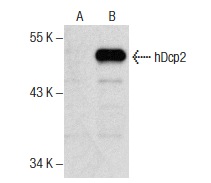
Western blot analysis of hDcp2 expression in non-transfected: (A) and human hDcp2 transfected: (B) 293T whole cell lysates.Application
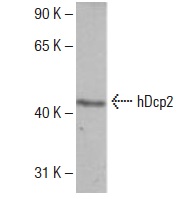
Western blot analysis of hDcp2 expression in Jurkat whole cell lysate.| Product Name | hDcp2 Antibody (V-25) |
|---|---|
| Antibody Type | Primary Antibodies |
| Antigen Alias | recommended for detection of hDcp2 of human origin by WB, IP and ELISA |
| Modification Notes | The major pathway of eukaryotic mRNA decay involves deadenylation-dependent decapping followed by 5’ to 3’ exonucleolytic degradation (4). Human decapping enzyme 2 (hDcp2) is an mRNA decapping enzyme which contains intrinsic decapping activity (1,2). In nonsense-mediated decay, the human decapping complex, made up of hDcp1 and hDcp2, may be recruited to mRNAs containing premature termination codons by nonsense-mediated decay factor (Upf) proteins (2). The decapping activator complex (Lsm1p-7p) is also involved in the recruitment of the decapping complex, indicated by data showing that Lsm1p-7p enhances the coimmunoprecipitation of the complex with mRNA (4). Dcp2 specifically hydrolyzes methylated capped RNA to release m(7)GDP, thereby aiding in mRNA degradation (1). Both Dcp1 and Dcp2 colocalize in the cytoplasm, which is consistent with their role in mRNA decay (3). |
| Clonality | Polyclonal |
|---|---|
| Isotype | IgG |
| Host Species | Rabbit |
| Tested Applications | WBIPELISA |
| WB:1:500~1:2000 IP:1:100~1:500 Notes:Optimal dilutions/concentrations should be determined by the researcher. |
|
| Species Reactivity | HumanMouseRat |
| Concentration | 1mg/ml |
| Purification | Affinity purified |
| Alternative Names | recommended for detection of hDcp2 of human origin by WB IP and ELISA |
|---|---|
| Tissue Specificity | recommended for detection of hDcp2 of human origin by WB, IP and ELISA |
| Entrez Gene | 167227 |
|---|
Application
Western blot analysis of hDcp2 expression in non-transfected: (A) and human hDcp2 transfected: (B) 293T whole cell lysates.
Application
Western blot analysis of hDcp2 expression in Jurkat whole cell lysate.| Application Notes | WB:1:500~1:2000 IP:1:100~1:500 Notes:Optimal dilutions/concentrations should be determined by the researcher. |
|---|
| Form | Liquid |
|---|---|
| Storage Instructions | For short-term storage, store at 4° C. For long-term storage, aliquot and store at -20ºC or below. Avoid multiple freeze-thaw cycles. |
| Storage Buffer | phosphate buffered saline , pH 7.4, 150mM NaCl, 0.02% sodium azide and 50% glycerol. |


