Application
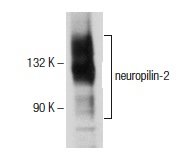
Western blot analysis of neuropilin-2 expression in COLO 320DM whole cell lysate.Application
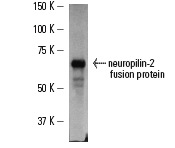
Western blot analysis of human recombinant neuropilin-2 fusion protein.| Product Name | neuropilin-2 Antibody (H-300) |
|---|---|
| Antibody Type | Primary Antibodies |
| Antigen Alias | epitope corresponding to amino acids 560-858 mapping within the extracellular domain of neuropilin-2 of human origin |
| Modification Notes | Neuropilin is a type I transmembrane receptor that has been implicated in aspects of axon growth and guidance and has been shown to act as a high affinity receptor for class III semaphorins and vascular endothelial growth factor (VEGF). A closely related protein, neuropilin-2, shares a common domain structure and signifcant homology with neuropilin and also acts as a receptor for the class III semaphorins and VEGF. Both neuropilins are involved in regulating many physiological pathways including axonal guidance and angiogenesis, however they exhibit differential expression in the adult vasculature. Neuropilin-2 is polysialylated and expressed on the surface of dendritic cells. It is also expressed by venous and lymphatic endothelium. Neuropilin is expressed predominantly by arterial endothelium. |
| Clonality | Polyclonal |
|---|---|
| Isotype | IgG |
| Host Species | Rabbit |
| Tested Applications | WBIPIFELISA |
| recommended for detection of neuropilin-2 of mouse, rat and human origin by WB, IP, IF and ELISA also reactive with additional species, including equine, canine, bovine and porcine: |
|
| Species Reactivity | HumanMouseRat |
| Concentration | 1mg/ml |
| Purification | Affinity purified |
| Alternative Names | epitope corresponding to amino acids 560-858 mapping within the extracellular domain of neuropilin-2 of human origin |
|---|---|
| Tissue Specificity | epitope corresponding to amino acids 560-858 mapping within the extracellular domain of neuropilin-2 of human origin |
| Entrez Gene | 8828 |
|---|
Application
Western blot analysis of neuropilin-2 expression in COLO 320DM whole cell lysate.
Application
Western blot analysis of human recombinant neuropilin-2 fusion protein.| Application Notes | recommended for detection of neuropilin-2 of mouse, rat and human origin by WB, IP, IF and ELISA also reactive with additional species, including equine, canine, bovine and porcine: |
|---|
| Form | Liquid |
|---|---|
| Storage Instructions | For short-term storage, store at 4° C. For long-term storage, aliquot and store at -20ºC or below. Avoid multiple freeze-thaw cycles. |
| Storage Buffer | phosphate buffered saline , pH 7.4, 150mM NaCl, 0.02% sodium azide and 50% glycerol. |


