Application
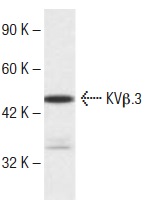
Western blot analysis of KVβ.3 expression in Jurkat whole cell lysate.Application
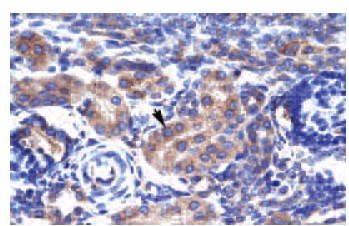
Immunoperoxidase staining of formalin-fixed, paraffin-embedded human kidney tissue showing cytoplasmic localization.| Product Name | KVβ.3 Antibody (L-21) |
|---|---|
| Antibody Type | Primary Antibodies |
| Modification Notes | Voltage-gated K+ channels in the plasma membrane control the repolarization and the frequency of action potentials in neurons, muscles and other excitable cells. The KV gene family encodes more than 30 proteins that comprise the subunits of the K+ channels, and they vary in their gating and permeation properties, subcellular distribution and expression patterns. Functional KV channels assemble as tetramers consisting of pore-forming å subunits (KV), which include the KV1, KV2, KV3 and KV4 proteins, and accessory or KV-subunits that modify the gating properties of the coexpressed KV subunits. KV∫.3 is an accessory K+ channel protein which regulates the activity of the pore-forming å subunit and alters the functional properties of Kv1.5. KV∫.3 localizes to the cytoplasm and is expressed in the brain, with highest expression detected in the cerebellum, and weakest expression seen in the frontal and temporal lobes. No KV∫.3 expression is detected in the heart, spinal cord, lung, liver, kidney, pancreas, placenta or skeletal muscle. |
| Clonality | Polyclonal |
|---|---|
| Isotype | IgG |
| Host Species | Rabbit |
| Tested Applications | WBIPIFIHCELISA |
| Species Reactivity | HumanMouseRat |
| Concentration | 1mg/ml |
| Purification | Affinity purified |
| Alternative Names | recommended for detection of KV&beta .3 of human origin by WB IP IF IHC(P) and ELISA also reactive with additional species including canine |
|---|---|
| Tissue Specificity | recommended for detection of KVβ.3 of human origin by WB, IP, IF, IHC(P) and ELISA; also reactive with additional species, including canine |
| Entrez Gene | 9196 |
|---|
Application
Western blot analysis of KVβ.3 expression in Jurkat whole cell lysate.
Application
Immunoperoxidase staining of formalin-fixed, paraffin-embedded human kidney tissue showing cytoplasmic localization.| Form | Liquid |
|---|---|
| Storage Instructions | For short-term storage, store at 4° C. For long-term storage, aliquot and store at -20ºC or below. Avoid multiple freeze-thaw cycles. |
| Storage Buffer | phosphate buffered saline , pH 7.4, 150mM NaCl, 0.02% sodium azide and 50% glycerol. |


