Application
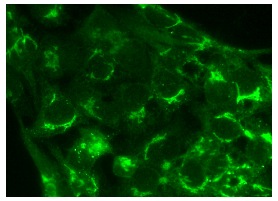
Immunofluorescence staining of formalin-fixed Hep G2 cells showing golgi apparatus and cytoplasmic localization.Application
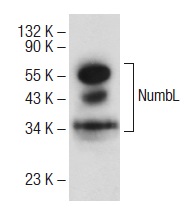
Western blot analysis of NumbL expression in Hep G2 whole cell lysate.| Product Name | NumbL Antibody (H-80) |
|---|---|
| Antibody Type | Primary Antibodies |
| Antigen Alias | epitope corresponding to amino acids 331-410 mapping within an internal region of NumbL of human origin |
| Modification Notes | In Drosophila, neuronal cell fate decisions are directed by NUMB, a signaling adapter protein with two protein-protein interaction domains, namely a phosphotyrosine-binding domain and a proline-rich SH3-binding region (PRR). The mammalian NUMB homolog plays a role in the determination of cell fate during development and binds with a variety of proteins, including Eps15, LNX1 and Notch 1. NumbL (NUMB-like protein), also known as Numb-R, NBL, CAG3A, CTG3a, NUMBLIKE or TNRC23, is a 609 amino acid cytoplasmic protein that, like NUMB, is thought to play a role in cell fate. Expressed at high levels in developing brain tissue, NumbL contains one PID (phosphotyrosine interaction domain) and plays an important role in neuronal differentiation, possibly associating with Eps15 and Notch 1. In mice, deletion of the NumbL gene is associated with early embryonic death, suggesting an essential role for NumbL in early development. |
| Clonality | Polyclonal |
|---|---|
| Isotype | IgG |
| Host Species | Rabbit |
| Tested Applications | WBIPIFELISA |
| recommended for detection of NumbL of mouse, rat and human origin by WB, IP, IF and ELISA also reactive with additional species, including equine, canine and bovine: |
|
| Species Reactivity | HumanMouseRat |
| Concentration | 1mg/ml |
| Purification | Affinity purified |
| Alternative Names | epitope corresponding to amino acids 331-410 mapping within an internal region of NumbL of human origin |
|---|---|
| Tissue Specificity | epitope corresponding to amino acids 331-410 mapping within an internal region of NumbL of human origin |
| Entrez Gene | 9253 |
|---|
Application
Immunofluorescence staining of formalin-fixed Hep G2 cells showing golgi apparatus and cytoplasmic localization.
Application
Western blot analysis of NumbL expression in Hep G2 whole cell lysate.| Application Notes | recommended for detection of NumbL of mouse, rat and human origin by WB, IP, IF and ELISA also reactive with additional species, including equine, canine and bovine: |
|---|
| Form | Liquid |
|---|---|
| Storage Instructions | For short-term storage, store at 4° C. For long-term storage, aliquot and store at -20ºC or below. Avoid multiple freeze-thaw cycles. |
| Storage Buffer | phosphate buffered saline , pH 7.4, 150mM NaCl, 0.02% sodium azide and 50% glycerol. |


