Application
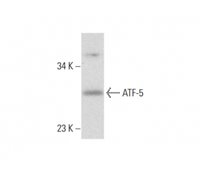
Western blot analysis of ATF-5 expression in human liver tissue extract.| Product Name | ATF-5 Antibody (H-83) |
|---|---|
| Antibody Type | Primary Antibodies |
| Antigen Alias | epitope corresponding to amino acids 1-83 mapping at the N-terminus of ATF-5 of human origin |
| Modification Notes | Eukaryotic gene transcription is regulated by sequence-specific transcription factors that bind modular cis acting promoter and enhancer elements. The ATF/CREB transcription factor family binds the palindromic cAMP response element (CRE) octanucleotide TGACGTCA. The best characterized members of this gene family include CREB-1, CREB-2 (also designated ATF-4), CRE-BPa, LZIP (also designated CREB3 and Luman), CREM-1, CREM-2, ATF-1, ATF-2, ATF-3, ATF-5, ATF-6 and ATF-7. This family of proteins contain highly divergent N-terminal domains, but share a C-terminal leucine zipper for dimerization and DNA binding. ATF-5 (ATFx), which can localize to the cytoplasm or the nucleus, binds DNA as a dimer. It interacts with CCND3 and PTP4A1. |
| Clonality | Polyclonal |
|---|---|
| Isotype | IgG |
| Host Species | Rabbit |
| Tested Applications | WBIPIFELISA |
| recommended for detection of ATF-5 of mouse, rat and human origin by WB, IP, IF and ELISA may cross-react with ATF-7 of mouse origin: WB:1:100~1:200 IP:1:20~1:100 IF:1:20~1:100 |
|
| Species Reactivity | HumanMouseRat |
| Concentration | 1mg/ml |
| Purification | Affinity purified |
| Alternative Names | epitope corresponding to amino acids 1-83 mapping at the N-terminus of ATF-5 of human origin |
|---|---|
| Tissue Specificity | epitope corresponding to amino acids 1-83 mapping at the N-terminus of ATF-5 of human origin |
Application
Western blot analysis of ATF-5 expression in human liver tissue extract.| Application Notes | recommended for detection of ATF-5 of mouse, rat and human origin by WB, IP, IF and ELISA may cross-react with ATF-7 of mouse origin: WB:1:100~1:200 IP:1:20~1:100 IF:1:20~1:100 |
|---|
| Form | Liquid |
|---|---|
| Storage Instructions | For short-term storage, store at 4° C. For long-term storage, aliquot and store at -20ºC or below. Avoid multiple freeze-thaw cycles. |
| Storage Buffer | phosphate buffered saline , pH 7.4, 150mM NaCl, 0.02% sodium azide and 50% glycerol. |


